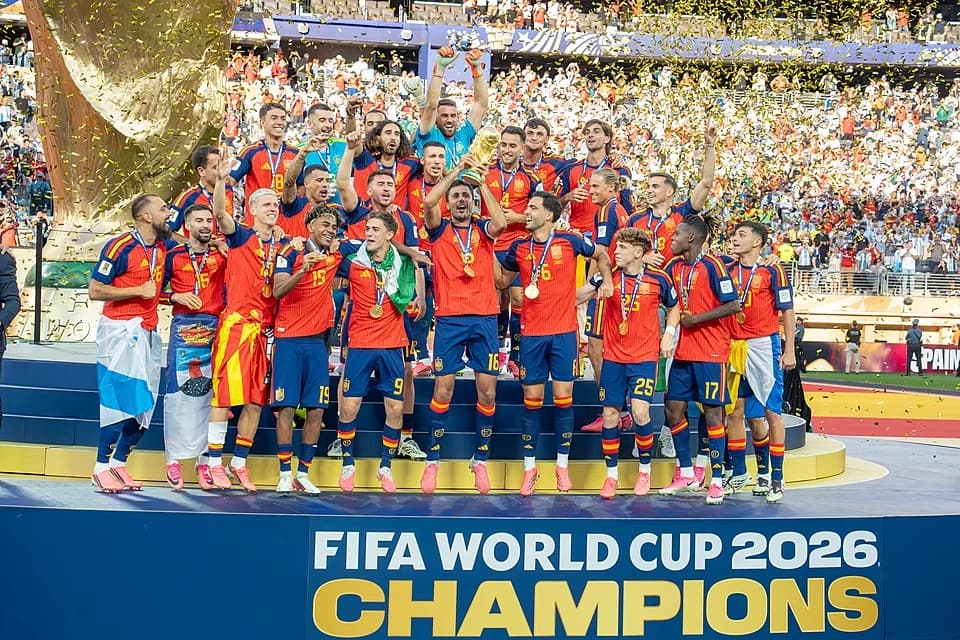
In a single evening, all the gold ornaments, statuettes and trophies in the Oval Office began to look even tackier. The real World Cup trophy was raised by the captain of Spain.
Donald Trump came to the final to present the trophy to the winner. When he walked onto the pitch alongside FIFA president Gianni Infantino, the crowd responded with boos. After the medals had been awarded, Trump did not immediately leave the podium. He remained beside the Spanish players until Infantino finally invited him to step aside before the trophy was lifted.
It made for an almost perfect scene: the man who had turned the Oval Office into a gilded salon had become part of the scenery for someone else's victory.
Trump does not restrict his interference to international politics. He finds it difficult to accept the existence of any space that refuses to obey his commands and whims.
During the tournament, he admitted that he had personally asked Infantino to review the red card shown to US striker Folarin Balogun. The suspension was put on hold, allowing Balogun to play against Belgium. The United States still lost 4–1. Political pressure worked. The sporting result proved harder to buy.
This was football, not the stock market, where unidentified traders can take profitable positions minutes before a presidential announcement sends markets moving, while the president's own investment accounts execute thousands of trades in the first three months of the year.
In football, it turned out, you cannot simply order the result you want. Not even when you have the FIFA president's direct number.
Before the final on July 19, Trump formally declared that he would not pick a side. He then did everything possible to leave no one in doubt about his preference: he reminded reporters of his friendship with Javier Milei and said that it was almost impossible to bet against Messi. It was a prediction in Argentina's favour, wrapped in the familiar Trumpian denial of the obvious.
His sympathy for Argentina was not only about Messi. Milei is one of Trump's closest ideological allies. At the same time, the US administration has grown increasingly open about treating the Western Hemisphere as a zone of special American influence.
An Argentine victory would have fitted neatly into the broader mythology of making America great again: Trump in Washington, Milei in Buenos Aires, Messi holding the trophy.
Spain represented a different image: a European country, a complex and diverse society, and a national team in which belonging was defined not by skin colour or the origins of a player's parents, but by what the players created together on the pitch.
That was why the intervention of former Spanish prime minister Mariano Rajoy looked particularly repulsive.
On the eve of the semi-final between Spain and France, Rajoy wrote that there were "no French players" in the French national team. French officials had to remind the former head of the Spanish government of an elementary fact: every member of the French national team was French. The Spanish government apologised to France.
Could Rajoy's words have affected the French players' mindset? We will never know. But the attempt itself was clear: to turn one of the tournament's most important matches into yet another European battle over migration, race and national identity.
Spain defeated France 2–0. Rajoy's reasoning looked especially pathetic when set against the Spanish team itself. Spain, too, refuses to fit the old ethnic model in which a Spaniard or a Frenchman must conform to an ageing conservative politician's idea of what the nation should look like.
Rajoy has almost no influence left in world politics. Yet with one racist remark, he managed to make the world talk about him again.
Nor was it surprising that Trump discussed a player's punishment directly with Infantino. FIFA's reputation has long encouraged politicians to treat such calls not as a breach of boundaries, but as a perfectly natural way of doing business.
US prosecutors alleged that members of FIFA's executive committee were bribed during the selection of Russia and Qatar as hosts of the 2018 and 2022 World Cups. Those events took place before Infantino became FIFA president, so it would be inaccurate to attribute the deals themselves to him. But the system he promised to reform quickly taught him its own rules.
In 2019, Vladimir Putin awarded Infantino Russia's Order of Friendship. In December 2025, Infantino presented Trump with FIFA's first-ever Peace Prize and a special medal. Human rights organisations demanded an investigation into whether the FIFA president had violated the organisation's principle of political neutrality.
One football match did not restore FIFA's reputation, defeat Trumpism or transform the world order. History rarely grants humanity such convenient victories. But Spain at least prevented the World Cup final from being completely turned into a political production.
Trump could call Infantino, push for a suspension to be reviewed, predict victory for the national team of a country led by his ideological ally, present the trophy and remain on the podium until he was asked to step aside.
But the only cup that mattered did not go to him. Spain defeated Argentina 1–0 and became world champions for the second time. The real gold went to Spain. Everything else was stage dressing.