We all felt the jolt. In the span of just a few days, the United States captured Venezuelan president Nicolás Maduro, detained several Russia-linked oil tankers in the Caribbean, and laid claim to Greenland under the banner of “global security.” At first glance, these moves look disconnected. They are not.
Taken together, they form a clear and increasingly familiar narrative: Washington is asserting that the military and economic presence of Russia and China near America’s borders has gone too far — and will no longer go unanswered.
Such abrupt actions by Donald Trump either rest on concrete intelligence assessments or signal a deliberate break with the old logic of containment. There is little room for a third explanation. Otherwise, the entire chain — from Caracas to Greenland — would amount to little more than performative noise without substance.
Against this backdrop, even the release of the Jeffrey Epstein files has faded into the background. The agenda has shifted abruptly: scandals and kompromat have given way to geopolitics and the redrawing of spheres of influence.
For some, what is happening produces a “wow” effect. For others, it triggers something closer to tangible fear. And judging by the pace of events, jaws are likely to keep dropping — more than once — in the near future.
FORTIFICATION MODE
Behind Donald Trump’s impulsive style, a colder logic has come into focus. He is not expanding an empire. He is rushing to reinforce its perimeter and divide the world into spheres of influence. It started with the wall on the Mexican border during his first term. Now it has escalated into claims over an entire hemisphere.
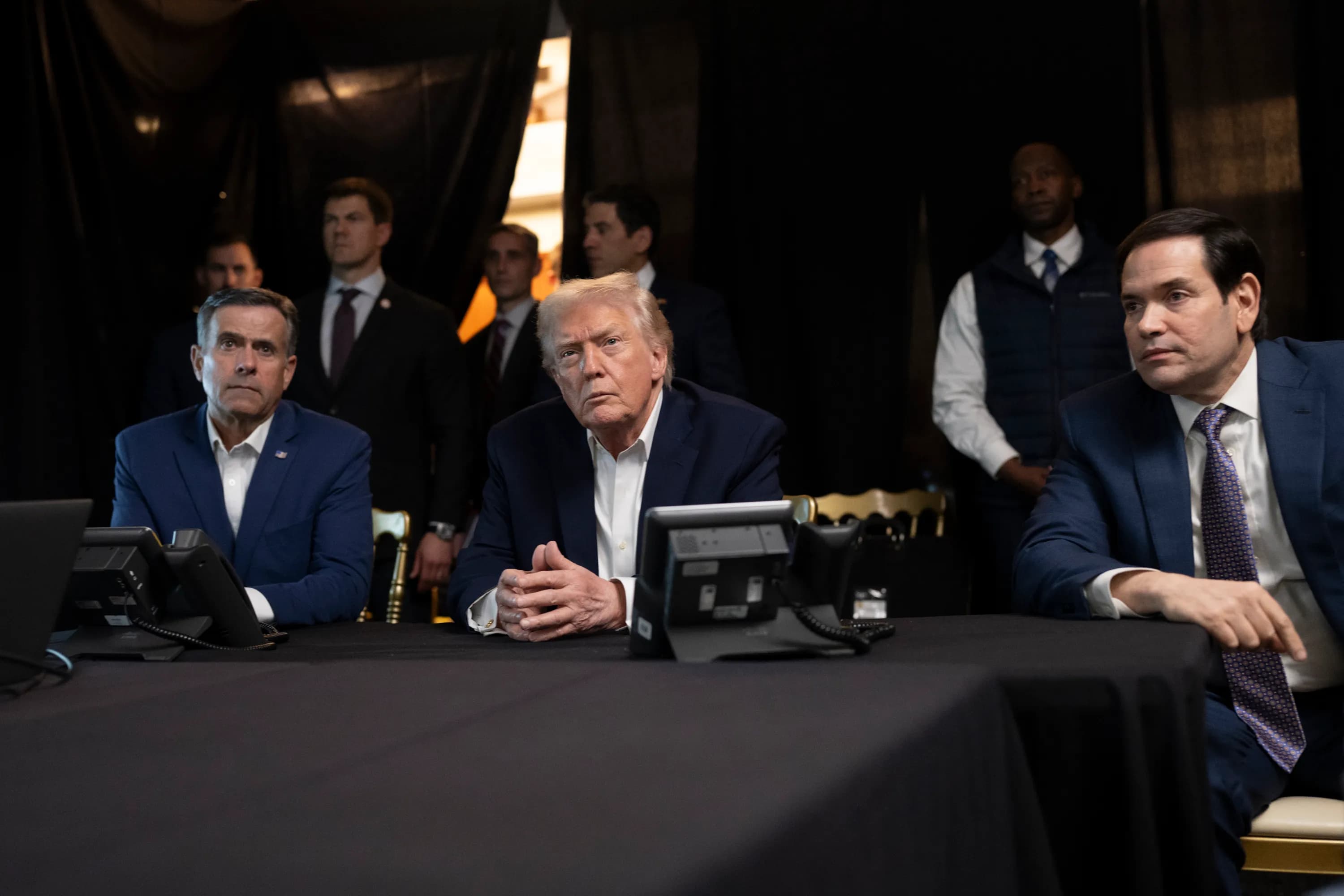
On the night of January 3, the world watched a blockbuster unfold in real life. Delta Force, backed by the Night Stalkers, carried out a blitzkrieg in the dark streets of Caracas — storming the home of a sleeping Nicolás Maduro, knocking him to the ground, and dragging him out alongside his wife within minutes.
The operation was backed by thousands of troops positioned along borders, naval forces, air power, and more than 150 aircraft. Congress was notified in real time. Trump and his team — Rubio, Hegseth, Ratcliffe — watched the live feed from Mar-a-Lago, like Call of Duty bosses. The rest of the world watched in shock.
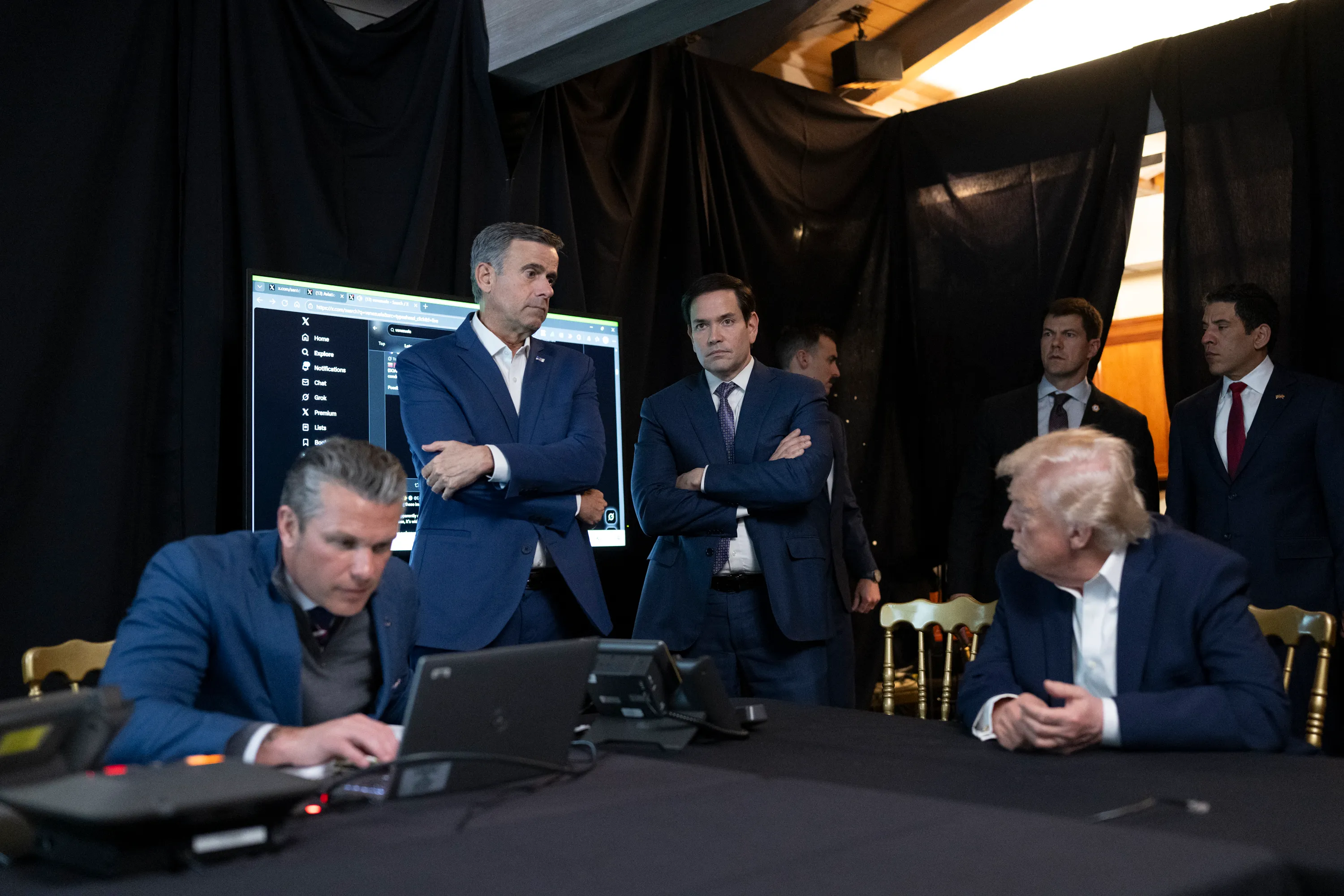
President Donald Trump observes the progress of Operation Absolute Resolve alongside Marco Rubio, Pete Hegseth, and John Ratcliffe. White House photo gallery, January 3, 2026.
From the outset, it was obvious that drug trafficking out of Venezuela was a smokescreen. The real reasons behind the lightning-fast overthrow and capture of Maduro became clear only later — in Washington’s rhetoric and official statements.
While the world argued over whether the United States was after Venezuelan oil and gold, Washington demanded something else entirely: that all U.S. adversaries engaged in military and economic activity inside the country leave immediately. No names were mentioned, but there was no real ambiguity. The message was directed at Russia and China — the very actors that had propped up Maduro’s regime, supplied weapons, extended generous loans, and embedded themselves in the management of Venezuela’s energy and resource sectors.
For anyone still underestimating the scale of what was unfolding, the U.S. State Department posted an image on X showing Donald Trump with a blunt caption: “This is our hemisphere.”
Almost immediately, Colombian president Gustavo Petro pivoted — dropping his earlier outbursts of outrage and signaling a willingness to cooperate.
Vladimir Putin and Xi Jinping fell silent. Their foreign ministries issued routine condemnations — and that was it. An emergency meeting of the UN Security Council convened only the following day, formally denounced the operation, and was promptly ignored. While diplomats talked, the first court hearing involving Nicolás Maduro was already underway just blocks away in New York.
Washington then moved quickly to assert claims over Venezuelan oil — flows that had previously reached Russia and China through sanctions-evasion channels. Days later, U.S. authorities seized the Russian-linked tanker Marinera (empty, but part of the shadow fleet), followed by the M/T Sophia under a Panamanian flag, carrying 2 million barrels of Venezuelan crude bound for China. Both vessels were tied to shadow shipping networks servicing Iran and Venezuela.
The parties most directly affected — Moscow and Beijing — swallowed that, too. Additional tankers suspected of operating in the shadows were detained shortly afterward.
At the same time, the language of the “backyard” returned to the American political lexicon. The southern perimeter, Washington insisted, required order — full stop. But the perimeter did not end in the south.
Almost in parallel, Washington resumed talking about Greenland — no longer joking about a “purchase,” but framing the island as a northern shield of national security. Official statements began invoking Russian and Chinese submarines near Greenland’s shores, Arctic vulnerabilities, and the need for rigid control. The south was sealed by Venezuela. The north — by Greenland. The center — the United States.
Trump argues that only full U.S. control over Greenland would allow America, as NATO’s key pillar, to guarantee security for both itself and Europe. Otherwise, he warns, the island could eventually fall under Russian or Chinese influence — even though there are, so far, no clear signals or immediate prerequisites pointing in that direction.
Venezuela as the Southern Node of the Perimeter
Many of my friends fled Venezuela. Not in search of a better life, but out of desperation — from the sense that nothing could be changed under the political course of Nicolás Maduro. Poverty, corruption, inflation, and crime became synonymous with the country. Their indicators rose almost geometrically, widening the social gap between the wealthy and everyone else.
Here in Spain, I am often asked the same question: how can people live so poorly in a country as rich and beautiful as Russia? My answer has usually been simple and uncomfortable. Enormous wealth itself often becomes the problem. Almost no Russian ruler managed to resist its glare. Resources and endlessly replenished state coffers dulled the sense of reality, slowly transforming power into a feeling of personal ownership. No matter how often life tried to correct this course, the same story repeated itself in Russia, again and again.
Something similar can be observed elsewhere today. Nicolás Maduro and his inner circle grew addicted to the golden needle, convinced of their own exceptionalism and impunity. Venezuela currently holds the status of the world’s largest holder of proven oil reserves — estimates consistently range between 300 and 303 billion barrels, roughly 18–20% of global reserves, formally placing the country above Saudi Arabia and the United States. That fact alone allowed the authorities to feel untouchable and dismiss sanctions outright — even as the lives of ordinary people slid into the abyss.
The rupture with the United States began back in 1999, with the rise of Hugo Chávez, who launched the ideas of the Bolivarian Revolution into the mainstream: anti-elitism, anti-imperialism, the dismantling of old institutions, and the concentration of power in the hands of the president. The American model came to be seen as hostile and dangerous. Anti-Americanism turned into a tool of regime self-preservation.
At the same time — also in 1999 — on the other side of the world, Vladimir Putin rose to power in Russia.
Chávez, and later Maduro and Putin, viewed the United States not as a partner but as a potential sponsor of regime change. Their rapprochement, however, rested on more than shared suspicion. Military and technical cooperation allowed Caracas to rattle whatever weapons it had, while Moscow used the relationship to irritate Washington — signaling that the Kremlin had a foothold in the Western Hemisphere.
Russia sent strategic Tu-160 bombers to Venezuela on several occasions. These visits, in 2008, 2013, and 2018, each triggered a sharp reaction from the United States. The cruise missiles carried by the Tu-160 have a range of approximately 4,000–5,500 kilometers, meaning that launches from Venezuela’s coastline could theoretically reach large portions of the U.S. East Coast within hours.
By 2026, U.S. intervention in Venezuela is being articulated explicitly through the language of the Monroe Doctrine. Donald Trump speaks of its revival, rebrands it as the Donroe Doctrine, and declares that American dominance in the Western Hemisphere “will no longer be contested.”
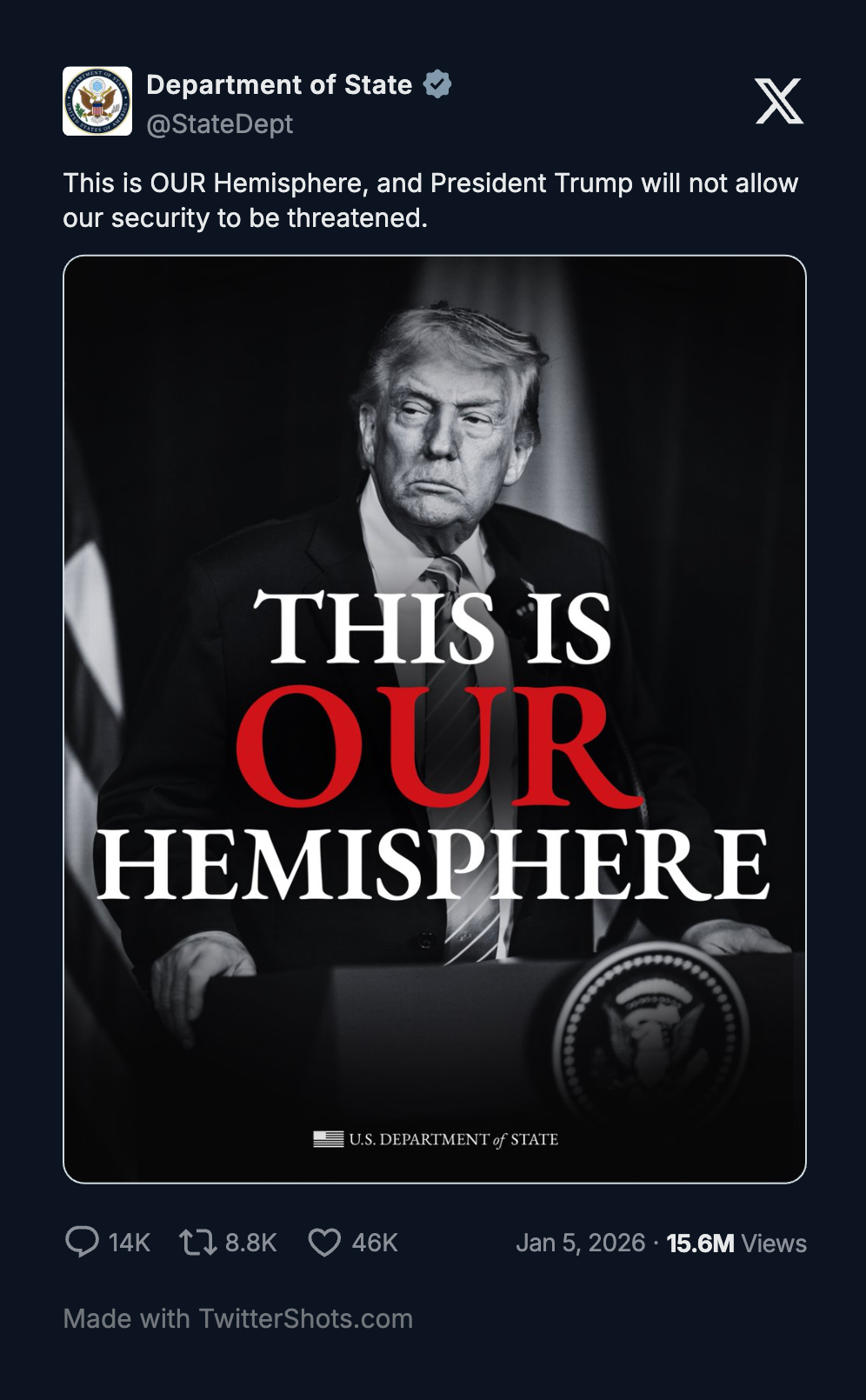
“This is our hemisphere.” Visual message published by the U.S. State Department on X amid escalating U.S. actions in Venezuela and renewed claims over Greenland. January 5, 2026.
In Trump’s framing, Maduro is not an autonomous dictator but a ruler who turned Venezuela into a platform for foreign adversaries and threatening weapons systems — a direct violation of two-hundred-year principles underpinning American policy.
China needed long-term access to oil; Venezuela needed cash. Democratic principles proved expendable for both sides. Iran and Venezuela, meanwhile, were bound by isolation. Tehran became a logistics partner, a source of sanctions-evasion technologies, and a participant in opaque oil schemes.
The Northern Flank
After Venezuela, the logic of the perimeter began to be articulated openly. Statements by Donald Trump about Greenland stopped being dismissed in Europe as eccentric rhetoric and started being read as a direct threat. In Copenhagen, officials described the moment as “decisive.”
A single glance at the map explains why. Greenland is a convenient forward position between North America and Europe — a gateway to the Arctic, key sea routes, and early-warning systems. Yet for decades the island remained weakly defended. Until Trump applied pressure, European leaders treated its security largely as a matter of paperwork rather than capability.
One point needs to be clarified. The United States is not entering Greenland from scratch. American military presence there dates back to 1951. Thule Air Base has long been integrated into missile defense and space surveillance systems. What is at stake is not a sudden invasion, but an attempt to expand and formalize control over the northern flank.
Trump consistently invokes the threat posed by Russia and China. Claims about submarines off Greenland’s shores may be exaggerated, but the risk of their future presence cannot be dismissed. In recent years, Moscow and Beijing have sharply increased their joint activity in the Arctic. The Ocean-2024 exercises — the largest in three decades — included drills focused on securing maritime routes, with icebreakers and submarines taking part.
The model is straightforward. Russia provides icebreaker fleets, infrastructure, and Arctic operational experience. China brings capital, technology, and long-term strategic planning. This hybrid partnership is not something to be ignored lightly.
The question, however, remains open: does this threat justify Washington’s attempt to pressure Europe through ultimatums?
Even during his first term, Trump publicly scolded European allies for chronically underfunding NATO. The Greenland episode only reinforced that diagnosis. It is no coincidence that only under the threat of annexation did several EU countries begin discussing a collective strengthening of the island’s defense through NATO.
Europeans are now trying to prove they can handle the task themselves. Britain has proposed deploying a mission with naval and air assets. Germany and Sweden are pushing for enhanced radar coverage and patrols. Italy and Belgium are calling for higher defense spending. Additional grants for Greenland are being discussed, aimed at preventing the island from yielding economically to American pressure.
Meanwhile, Trump’s rhetoric continues to harden. He insists that if the United States does not secure Greenland, Russia or China eventually will. Hence the offer of an “easy way or a hard way.” Officials in the White House say all options are on the table, including military ones. Democrats in Congress introduce resolutions in opposition; Republicans either remain silent or express support.
The northern flank is being sealed in the same manner as the southern one — fast, bluntly, and with little regard for allies.
Division of Spheres of Influence
Many days have passed since the capture of Nicolás Maduro. Everything has been said: resolutions, condemnations, emergency meetings, foreign ministry statements, expert commentary. Everything — except one thing. There has not been a single personal public statement from Vladimir Putin or Xi Jinping.
This is unlikely to be a pause for drafting positions. In diplomacy, silence by leaders is also a form of speech. Sometimes the most meaningful one. Such silence often appears not when there is nothing to say, but when there is no intention to intervene.
I am not a fan of conspiracy theories. But this silence is too conspicuous to be ignored. It may point to an unspoken division of spheres of influence.
For Russia, the existential direction is clearly Ukraine. This is where resources, military stakes, political prestige, and regime risks are concentrated. For the United States, that role is increasingly played by the Western Hemisphere — with Venezuela and Mexico as key nodes. In this logic, Caracas and Kyiv are not directly linked, but they appear as structurally mirrored cases.
This is what a tacit recognition of the boundaries of what is permissible between two major powers might look like. The Anchorage summit was publicly assessed by both sides in strikingly positive terms. The demonstrative warmth of that meeting signaled to the world that Donald Trump and Vladimir Putin were on the same wavelength and understood each other perfectly.
The United States is acting in Venezuela with speed and brute force — and receives no reciprocal escalation. Russia continues to press along the Ukrainian track and sees that Western pressure remains limited, fragmented, and extremely cautious.
China appears to be playing a different game altogether. That is why it remains silent. The loss of Venezuelan oil supplies is easily offset for Beijing through Russia and other East Asian partners. Venezuela provides China with roughly 300–400 thousand barrels per day against total consumption of 11–12 million. That is around 3–4% — a volume easily replaced by Russia alone (already +500 thousand barrels per day in 2025), as well as by Saudi Arabia, Iran, and Malaysia.
At the same time, Venezuelan oil can be redirected toward the United States and the European Union, which would no longer have to wrestle with the moral discomfort of energy dependence on Russia. The new authorities in Caracas — Delcy Rodríguez — are already signaling a reorientation of exports toward the West.
In this sense, the entire situation may end up reshaping the oil market under a new set of rules. Tellingly, oil prices have reacted with near-total indifference. Since January 3, Brent has fluctuated within the $72–75 range — no panic, no collapse. The market has already swallowed the seizure and remains silent, along with Putin and Xi.