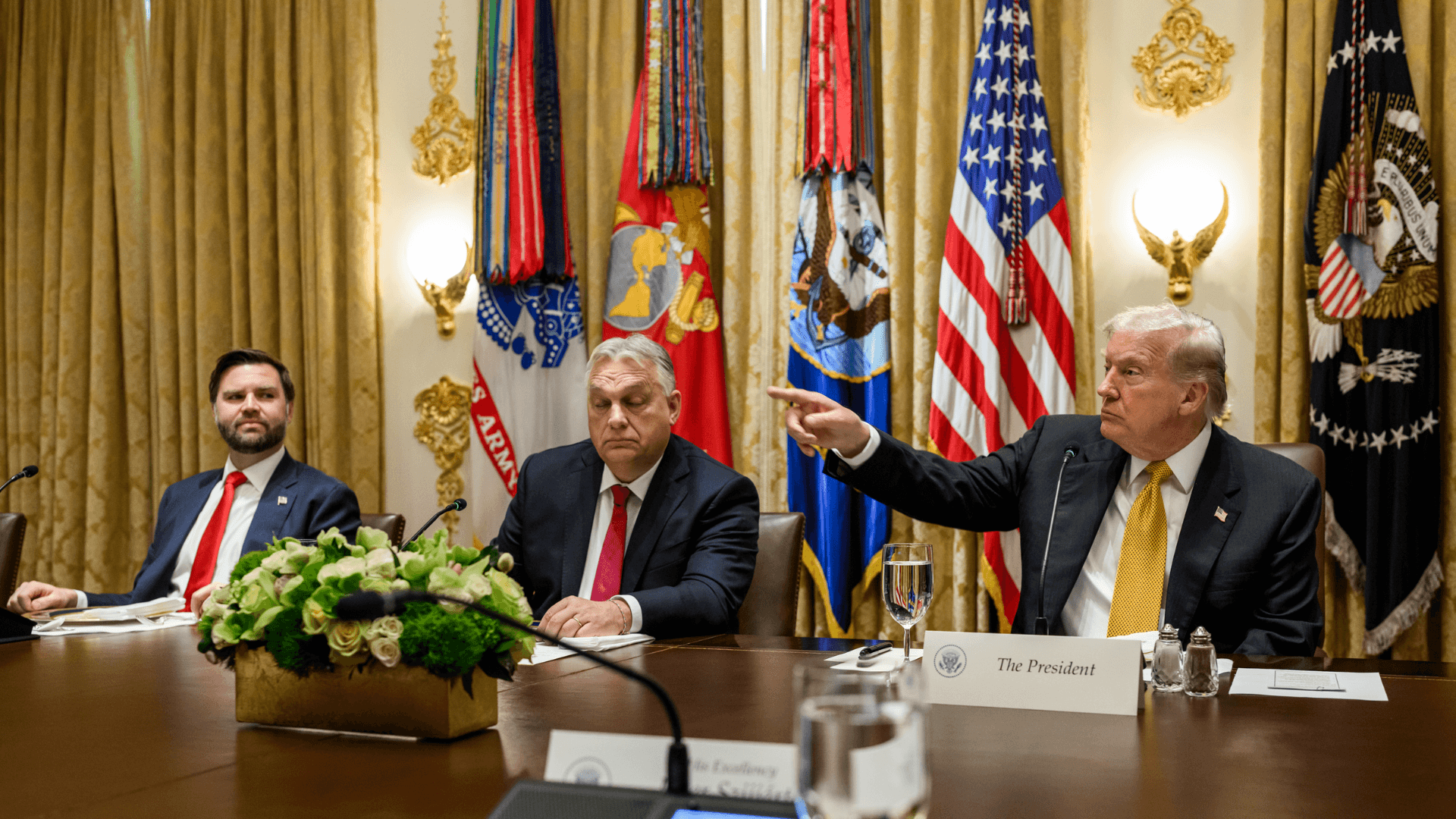
At first, it looked like a string of random setbacks. Now it looks more and more like a pattern. Viktor Orban's defeat in Hungary, the collapsed talks with Iran in Islamabad, rising prices amid the blockade of Hormuz and new tariffs, all of it adds up to a streak of failures trailing Donald Trump.
The president still talks in terms of "great deals" and in the language of MAGA. In his rhetoric, everything is upbeat, tough, and under control. But in reality, foreign policy is stalling, allies are losing, and economic decisions are hitting his own side. And the wider the gap between rhetoric and results, the more it hurts those who bet on him.
Questions about Trump's judgment and competence are no longer coming only from his opponents. They are now being raised on the right too, in the very camp that only recently treated him as an almost uncontested figure. Trump's political image is lining up with reality less and less. If his first failures could still be written off as elite resistance, bad luck, or the "price of strength," a different question is now surfacing more often: is this really about circumstances, or about Trump himself?
In Search of Logic
After the talks in Islamabad, Trump declared that if Iran failed to let all vessels through the strait, the United States could shut it down completely. At first, this sounded like yet another impulsive gesture. Experts and allies warned that such a blockade would only escalate the conflict and hammer global markets. Gradually, however, a different logic began to emerge: Trump appears to be trying to move the confrontation from the military realm into the economic one.
The apparent plan is to make Iran choke on its own oil, forcing it to cut production, shut down wells, and eventually risk losing parts of its infrastructure. Blocking the ports would hit not only exports, but also supply chains, trade links, and internal stability, ramping up domestic pressure on the regime.
Trump is likely to play the same card in the upcoming negotiations with China, scheduled for mid-May. Beijing depends on Middle Eastern oil for roughly 60 percent of its needs, so pressure on Iran also serves as an indirect signal to Beijing: cut support for Tehran and become more flexible in broader bargaining with Washington.
On April 17, Iran opened the strait. Trump presented it as a breakthrough. Tehran responded that the strait had reopened because the United States had backed down and accepted its conditions, including an end to Israeli attacks on Lebanon. Just one day later, the Strait of Hormuz was closed again, with Tehran demanding that the U.S. lift its blockade of Iranian ports.
The IRGC demonstrated that it controls not only the waterway itself, but the political narrative around it as well: oil prices dropped while the strait was open, and China symbolically received a small shipment of oil.
The situation is trapping Trump in a political bind. Midterm elections are coming later this year, and a new presidential campaign begins in two years. Iran has made it clear that it is ready to endure and wait this out. The American voter, by contrast, is unlikely to tolerate expensive gasoline, inflationary pressure, and business anxiety for long. Against this backdrop, Trump's approval rating continues to slide.
Trump's chaos may not be without its own internal logic. But his strategy in Iran is so crude and high-risk that it is rapidly becoming a threat not only to America's adversaries, but also to its allies, global markets, and American voters themselves.
Even on the domestic front, Trump's initiatives are failing to deliver the expected results. Tariffs on imports, sold as a way to protect the economy, restore American strength, and shield domestic industry, have instead produced higher costs, pressure on businesses, and rising prices. It is the American consumer, not the foreign importer, who ultimately pays the bill.
Courts have already struck down key elements of Trump's original tariff framework, ruling several measures unlawful. Lawsuits have now been joined by 24 states and individual small businesses. A baseline global tariff of 10 percent is currently in effect as a temporary measure, while the White House has signaled its intention to raise it to 15 percent.
The only clearly positive episode in Trump's record so far has been the capture of Nicolas Maduro, and even that comes with caveats. The operation to arrest and extradite the Venezuelan president did make a powerful impression. Daring U.S. special forces, flawless intelligence work, and real-time artificial intelligence analysis stunned the world. Trump celebrated.
Yet one such success is nowhere near enough to offset the broader streak of failures. What's more, the basis for the arrest, drug trafficking from Venezuela into the United States, raises serious legal questions.
In Trump's Wake
Viktor Orban's crushing defeat in Hungary's parliamentary elections can be directly linked to Donald Trump's falling approval rating. Negative public sentiment continues to build around the American president. As of April 19, only 37 to 40 percent of Americans approved of his performance.
It is only natural that any association with Trump now damages the image of his closest allies and those he publicly endorses. Orban received an unprecedented level of support, the most advanced campaign technology, top strategists, and the best political operatives. Yet after sixteen years of absolute power, his Fidesz party managed just 38.6 percent of the vote and 52 seats out of 199.
Trump, sinking under his own low approval ratings, is dragging the Republicans down with him. Every mistake becomes dead weight for a party where the first clear signs of fracture are already visible. And midterm elections are still ahead.
One of the leading dissidents is Thomas Massie, who called the war "not America First" and forced Congress to hold two votes on the War Powers Resolution. Former hardcore MAGA loyalist Marjorie Taylor Greene publicly raised the possibility of invoking the 25th Amendment. "All I heard was WAR WAR WAR," she said after the president's speech.
Support for Trump is visibly weakening inside his own party, and the volume of discontent keeps growing. Even the right-wing media ecosystem has erupted in criticism.
Longtime loyalist Tucker Carlson has condemned Trump's actions in Iran and urged the White House to tell the president "no," even on nuclear codes. Television host Megyn Kelly points out that Trump is "too gullible, too weak to say no to Israel" and is already losing his white working-class base. Candace Owens has called for the 25th Amendment. And Alex Jones, who once said he would die for Trump, now claims that "Trump is under demonic influences... the man he once was has changed."
Trump dismissed all four as "low IQ losers." Yet the split at the very heart of MAGA can no longer be ignored.
Meanwhile, Putin stands on the sidelines and watches. He does not loudly condemn the war; he simply plays his own game. Thanks to the Hormuz blockade, for which Trump is being blamed, the Kremlin has patched its financial holes with soaring oil prices and has likely channeled the windfall straight into its war in Ukraine.
Western intelligence is confident that Russia is helping Iran with satellite imagery and reconnaissance data. Trump, however, barely comments on it. Since the war in Iran began, the entire topic of U.S.-Russia relations, and of Putin and Trump personally, has vanished from the agenda.
Trump's Last Living Asset
Trump was not elected to govern. He was elected to strike at the elites and the old order. He promised to smash the administrative state, to purge the corrupt system. His rhetoric focused on mass deportations, attacks on diversity and DEI programs, the fight against "transgender ideology" in schools, and the rollback of climate and environmental initiatives. In foreign policy, he vowed to pressure allies into paying more and obeying American demands; for him, NATO was never a sacred alliance. It was always a bargaining chip.
In a sense, this remains his last living asset. Trump is still persuasive to those who despise the old system, distrust liberal elites, and crave not reform but a spectacular act of destruction. The problem is that destruction alone is not a governing program. The more Trump tears down, the more often the same question arises: what exactly does he intend to build in its place?
Critics point out that the president is increasingly occupied with golden trim in the Oval Office and the construction of a 90,000-square-foot ballroom costing $400 million on the site of the historic East Wing. He has also turned the Rose Garden into a stone patio in the Mar-a-Lago style. These "small touches" are a natural extension of his governing aesthetic: fewer institutions, more personal taste; less system, more monarchical decor.
Toxic Burden
Trump is increasingly being described as a "toxic burden," a "liability," or a "source of weakness" for the United States and its allies. His closest ideological allies in the EU, Marine Le Pen in France, Alternative for Germany, and the Italian right, are distancing themselves from him, viewing any association with Trump as politically toxic. They fear it is becoming an electoral liability, especially after Viktor Orban's defeat.
Politico puts it bluntly: "Donald Trump has become so politically toxic in Europe that even his closest ideological allies increasingly view him as a liability."
The Trump administration does more than irritate allies. It weakens them, erodes trust, and leaves behind a vacuum that China and Russia are quick to fill. The Center for American Progress has already counted 111 specific ways in which Trump is undermining American security, economic strength, and global influence.
The New York Times puts it this way: "America's reliability is increasingly in question. Even nations not directly impacted can perceive the trajectory of U.S. policies."
What the world sees in Trump's politics is not partnership, but a purely transactional approach of a financial predator. The Straits Times sums it up harshly: "Mr Trump’s transactional approach runs counter to NATO’s core principle of mutual support... The signal sent by Trump is catastrophic for NATO’s credibility."
The question is no longer whether Trump himself can hold on to power. The question is who will manage to break away from him first.