Donald Trump's approval ratings are higher than those of many major European leaders and comparable to some others, despite an enormous level of rejection. At the end of May, his approval rating held steady around 35-40%. This is higher than the favorable rating of British Prime Minister Keir Starmer (24%), French President Emmanuel Macron (23%), and German Chancellor Friedrich Merz (22%), and roughly comparable to the figures for Spanish Prime Minister Pedro Sánchez (38%) and Italian Prime Minister Giorgia Meloni (35%).
Trump maintains this level despite scandals involving the Epstein files where his name appears, the protracted conflict in Iran and the blockade of the Strait of Hormuz, stalled domestic policy, and ongoing discussions about his health and cognitive state.
Noise does not always raise Trump's rating. That would be too simple a formula. What noise does is keep him at the center. And in modern politics, centrality is sometimes more important than affection.
European politicians who play by moral norms look unpopular and simply boring against the backdrop of the United States, where absurdity has become almost a political norm.
The phenomenon of Trump's rating can be explained by the fact that the American president exists not only within ordinary politics. He exists within the attention economy. For him, negative publicity is fuel. Scandal does not destroy his image, it serves it. A beautiful abomination, but a working PR mechanism.
And even in moments when Trump's rating fell to record lows for his second term, he never lost his centrality. But where does it come from and how is such a result achieved?
To explain this phenomenon, I decided to draw a comparison with the X algorithm. The X algorithm does not need a post to be smart, truthful, or morally worthy. It needs movement around the post: replies, quotes, arguments, lingering attention, irritation, and repeated returns to the topic. In this environment, conflict often spreads better than competence.
Trump operates by the same logic. He needs to provoke a reaction. Where there is reaction, there is attention. Where there is attention, there is centrality. Where there is centrality, there is political pressure. Conflict gives him centrality, and centrality gives him the maximum audience.
Trump threatens to bomb Iran not only to make the adversary more compliant, but also to make the whole world discuss his absurd statements. Even footage of bruises on his hands or supposed dozing off during events generates a huge audience that begins comparing him to Joe Biden and questioning his presidential competence. In this case, Trump did not become the hero of the meme about feeble Biden. Rather, he skillfully manipulates it to his advantage.
When the media, liberals, European leaders, courts, universities, cultural elites, or opponents express outrage, they think they are weakening him. But often they are simply amplifying his presence. Scandal does not push him out of the system, it returns him to the center.
The conflict with Spain, which refused to provide the United States with its military bases for strikes on Iran, and with other European countries initially threatened a rupture in economic ties with NATO partners. But in reality, inside the United States it gave Trump support and new MAGA followers who began speaking louder about ending aid to foreign states and closing ranks.
Trump tries not to drop out of the news agenda for a single day. Mandatory interaction with journalists is part of his daily schedule. It has become so constant that a day when he does not appear in public forces the media to suspect something is wrong.
His team actively promotes the thesis: "Trump is the most public president in the world." And there is no arguing with that, because such publicity was probably matched only by the late Venezuelan leader Hugo Chávez, who could spend five hours on live television every Sunday answering viewers' questions.
Even an experienced blogger would envy Trump's media activity. In addition to almost daily press interactions, he manages to create memes and post on his Truth Social; all of this is actively reposted by his team, protocol staff, press service, and other White House offices.
Trump himself creates a powerful information flow that spreads around the world in a matter of minutes. Journalists calculated that in April 2026 he published 565 posts on Truth Social, an average of about 18 per day, with roughly a third posted at night.
The U.S. president's activity in this term has increased dramatically. In the 132 days since the inauguration, he has published 2,262 messages. This is three times more than during the same period of his first term.
Trump is not just fighting for attention. He is creating an attention barrier. His conflict-driven approach clogs the channel. Everyone else looks pale not only because they are boring, but because the public space is already occupied by his noise.
Who is making noise next to him? Kamala Harris? Right now she does not appear to be a source of alternative noise. Her activity is much lower than during the election campaign, and she figures more as a potential 2028 candidate than as someone who competes with Trump for the agenda every day.
Pelosi once fit the role of Trump's ideal opponent perfectly, but now her appearances look more like the epilogue of a long career than a fight for daily attention.
Gavin Newsom looks like a promising noise counterweight, but he rarely rises above the level of a regional or intra-party national brand rather than a constant nationwide agenda-grabber. He is capable of bursts, but so far he does not create steady pressure against Trump's background.
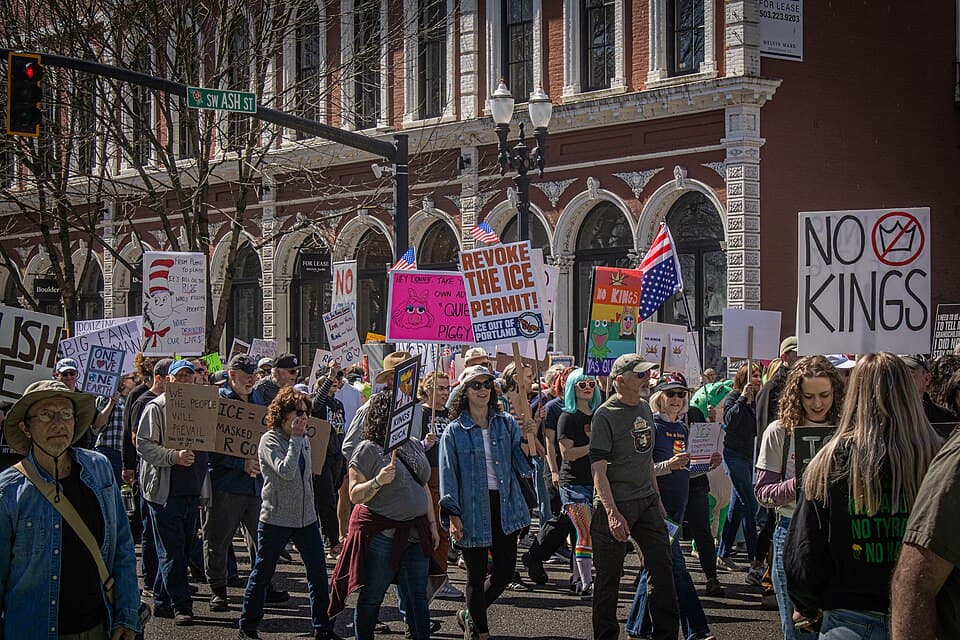
What actually breaks through the barrier now is not individual political leaders but mass events. Protests like "No Kings" in March 2026 became the largest demonstrations against Trump's policies. But this is already a collective stage of conflict.
Another type of competitor is an external factor, especially Iran, China, and trade policy. But even with Iran, Trump repeats so often and so loudly that "everything is under control," negotiations are continuing, and there will be a "great deal" that rebuttals to his words are practically inaudible.
European leaders lose out against this backdrop as media objects. Their media activity is limited to statements from podiums, participation in summits and meetings, and newspaper articles. They do not generate absurd memes, rarely answer journalists' questions, and live by the schedule.
The only one who stands out is the Spanish prime minister. Pedro Sánchez's sagging rating suddenly began to grow rapidly after he deliberately entered an open conflict with Elon Musk and then with Trump himself.
In February 2026, Sánchez announced a tough package of social media measures: a ban on access to platforms for children under 16, criminal liability for owners and top managers who refuse to remove "hate content" and disinformation. He directly accused X of spreading fakes about mass migrant legalization. Musk responded in his signature style: "Dirty Sánchez, a tyrant and traitor to the Spanish people," and later added "fascist totalitarian." Sánchez did not make excuses, he went on the attack, calling Musk and the like "techno-oligarchs" the main threat to democracy and the mental health of young people. The noise became international.
And in March, Sánchez's rating rose even higher amid the spat with Trump. Spain refused to provide the United States with its military bases (Rota and Morón) for strikes on Iran. Trump called it an "unfriendly act" and threatened to break trade ties. Sánchez responded clearly and firmly: "No to war." He turned a potential foreign-policy disaster into a powerful domestic narrative, "the defense of Spain's sovereignty and international law against a mad American adventure."
And this is where Sánchez began playing by exactly the same algorithm as Trump, only from the left flank. Instead of hiding from scandals (and he has plenty, corruption cases involving his wife, brother, former key PSOE allies, and raids on party headquarters), he uses them as proof of "political persecution" by elites and oligarchs. Every new court case, every loud statement from Musk or threat from Trump is not a blow to his rating but an additional boost to his centrality. Conflict gives him exactly that "friction" which in politics works better than any noble programs.
As a result, while the ratings of Macron, Merz, Starmer, and other European "moral" politicians continue to slide downward, Sánchez turned out to be one of the few major European leaders who managed, at least temporarily, to turn conflict into a source of centrality.
Unlike Trump, European leaders look more competent, institutional, and cautious, but in algorithmic publicity this looks like absence.
The language of briefings, procedures, and balance they speak is a virtue in old politics. But in the new environment, it spreads poorly.
Trump, on the other hand, lives by the principle that "politics is the attention market." That is why the question asked by the European press sounds imprecise. They ask: why does Trump remain popular despite the absurdity, noise, rudeness, corruption, and scandals?
But the right question is different: what if scandal does not destroy his image but sustains his centrality?
Trump does not necessarily become more loved. His rating can fall. Approval can be low. But he still remains the main object of discussion. And in modern politics, centrality itself is power.
Every time his opponents respond with nothing but moral outrage, they confirm his role: "the man against the system." They do exactly what his attention machine needs, they create reaction, conflict, and explosive spread.
This does not mean Trump cannot be criticized. It means he must be criticized in a way that does not feed his centrality. And that is much harder than simply saying "he is terrible." Politics has turned into a quest: try to expose the fire without adding oxygen to it.
On May 31, 2026, Trump unleashed a record spray: AI images of himself on Mount Rushmore, an UFC cage in the White House, a golden dome, and attacks on Biden, Obama, the Pope, and Rosie O'Donnell. More than 50 posts in a single day. Harry Sisson (one of the most prominent anti-Trump voices) immediately published a long thread: "Trump had another mental health episode today... Impeachment and removal NOW."
The result? Sisson's post gained over a million views, thousands of replies and quotes. Instead of "exposing the madness," the critics themselves turned Trump's day into the main news event. Trump remained at the center, and his rating stayed at 40%.
https://x.com/harryjsisson/status/2060907024913678502
The same pattern was seen with the Epstein files. When Trump's name surfaced in the documents, liberal media and Democrats unleashed a full moral storm: headlines reading "Trump and Epstein," demands for investigation, calls for impeachment. They sincerely believed it would destroy him. In reality, Trump received free traffic for weeks. Every new "exposé" only strengthened his narrative of "they are trying to destroy me again because I threaten the system." And the rating did not collapse.
When Sánchez refused to allow use of the Rota and Morón bases, European leaders and American Democrats unanimously condemned Trump as a "mad warmonger" and "threat to NATO." The moral outrage was loud and unanimous. Inside the United States, it instantly became fuel for MAGA: "Look, even our European allies are betraying America." Trump gained a new wave of support from those tired of "foreign aid," while his opponents once again found themselves in the role of "defenders of foreign interests."
The main mistake of Trump's opponents is to respond to his provocations as if they were deviations from politics. For Trump, provocation is politics. He does not produce conflict by accident. He produces it as a resource. Every moral outrage, every hysterical column, every television hour devoted to his latest "unthinkable" phrase does exactly what he needs: puts him back at the center.