Uwe Boll's Citizen Vigilante, from a director long branded "the worst in the world," is being accused of inciting violence against migrants and promoting racism. Others say the film finally shows what people in the West prefer to discuss only in whispers. But what matters now is no longer the film itself, or even its artistic quality. The scandal around Citizen Vigilante and the restrictions on its release have become a trigger revealing how deeply Western societies are divided over migration, crime, and justice.
The main character, an American in Europe played by Armie Hammer, sees how the justice system shields rapists, murderers, and corrupt judges, especially when the perpetrators come from "vulnerable" migrant groups. He takes the law into his own hands and methodically kills them. As a result, he becomes a hero on social media and a public enemy of Interpol and the police. The final scene, which both infuriates and excites viewers: he executes an entire Syrian migrant family because their son took part in the gang rape of a local girl and got away with probation.
The film is presented as being based on real cases. And those who live in the EU and the US have to admit it: discussing migration without moral blackmail, bans, and labels has become almost impossible. Uwe Boll suddenly looked less like a director than a detector of political panic.
The Fear of Being Called Intolerant
Every time a murder is committed in the West by a migrant or someone with a migrant background, the horror and outrage often stay silent. People see it on each other's faces, but many prefer not to say it out loud, especially in public. It's too easy to get branded a Nazi, a fascist, or any number of other sins. At times, it feels like these crimes are meant to be discussed as little as possible and forgotten as quickly as possible.
But sometimes the tension breaks through, in protests and raw public anger.
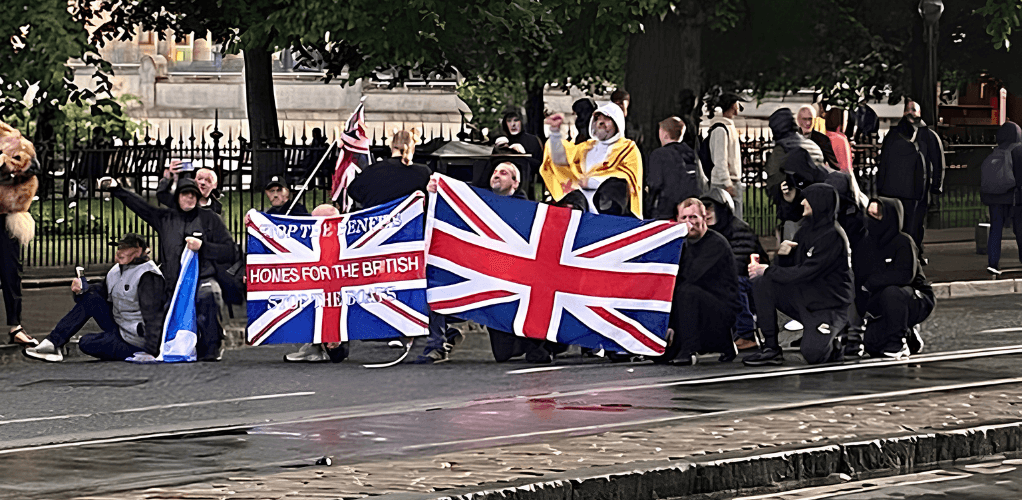
Take Britain in June 2026. Protests erupted after details surfaced of the murder of student Henry Nowak in December 2025. He was stabbed five times. The killer was 23-year-old Vickrum Digwa, a Briton of Indian descent from a family with a migrant background. When the police arrived, Digwa and his brother lied: they claimed Nowak had racially abused them, attacked first, and hadn't even been stabbed. The police believed them. Nowak lay on the ground saying "I've been stabbed" and "I can't breathe." One officer replied, roughly, "I don't think you have, mate." They put handcuffs on him while he was dying.
The fear of being accused of racism or appearing intolerant often stops people from reacting properly to crime.
When Restriction Turns Into Publicity
Watching Citizen Vigilante, you freeze from the very first minutes. The violence and horror on screen hit hard. The film faced serious restrictions in Germany after it was denied an age rating by the FSK. Director Uwe Boll called it censorship and, in protest, released the movie for free on X. Later, Elon Musk shared it on his own account.
Musk often posts about the problems of mass uncontrolled migration, and for that he gets accused of racism and flirting with fascist ideas. It is the classic tactic: attack anyone who brings up uncomfortable data.
In his posts, Musk has compared fertility rates across countries and pointed out that in Europe, non-Europeans, especially from certain regions, are heavily overrepresented in statistics on violent and sexual crime. All of this points to a clear failure of integration. Instead of successful integration, Europe got parallel societies, Sharia patrols, grooming gangs, rising antisemitism, and anti-Western sentiment.
Sometimes it feels like the word "fascism" has become a universal emergency brake on any discussion. When one word is used for both actual neo-Nazis and someone who simply asks about deporting a rapist, language stops describing reality and starts protecting it.
But the noise around Musk's posts exists largely because he owns the platform where banned or semi-banned content can instantly become a global event. That is why the old system sees him as a threat.
Data That Labels Can't Erase
Official statistics in Europe show that in some countries certain migrant or post-migrant groups are overrepresented in specific types of crime, especially violent and sexual offenses. The size of the effect depends on age, gender, income, area of residence, and how the data are recorded.
It is important to be clear: this is not about "all migrants," but about concrete disparities in specific groups.
In Sweden, the Brå report from the Swedish National Council for Crime Prevention states directly that the risk of being registered as a suspect is noticeably higher among those born abroad than among those born in Sweden to two Swedish-born parents. For the second generation, those born in Sweden to two foreign-born parents, the risk is often even higher. Even after adjusting for age, gender, income, education, and municipality type, the gap shrinks but does not disappear completely. This is especially visible in serious categories: rape, robbery, attempted murder, and completed homicide.
In the United Kingdom, the Casey report on grooming gangs and group-based child sexual exploitation is one of the most damning documents. It does not offer a simple racial formula, but it clearly records that in Greater Manchester and West Yorkshire a disproportionately large number of suspects were of Asian ethnicity, mainly Pakistani. The most important point in the report is not ethnicity itself, but institutional failure: for years, authorities and police avoided the topic of cultural and ethnic factors out of fear of being accused of racism. It was this fear that prevented them from protecting victims.
In Germany, BKA statistics are more complicated. They often count "non-German suspects," a category that includes not only migrants but also tourists, people living in Germany illegally, stateless people, and others without German citizenship. Nevertheless, reports on crime in the context of migration (Lagebild Zuwanderung) record a significant share of non-German suspects in violent crimes. Again, this is not about "all migrants," but about specific groups and specific types of offenses.
The main conclusion is this: yes, real statistical disparities exist. Yes, they depend on age, gender, socio-economic status, and country of origin. But denying their existence, or explaining everything solely through "poverty and discrimination," is also self-deception. An even greater self-deception is when the fear of the "racist" label paralyzes institutions and prevents them from protecting people.
The Demographic Deal Sold as Morality
Europe is genuinely aging. The numbers from Eurostat are clear: the share of the working-age population is falling, while the old-age dependency ratio is rising, from 34.4% in 2025 to a projected 61.9% by 2100. Pensions, healthcare, and social services face real pressure.
Mass migration became a convenient answer to this challenge. It was sold as a moral necessity and an economic lifeline. In practice, it was a political choice: cheap labor for business, a demographic patch for the state, and a moral project for progressive elites.
And it is precisely this choice that is now cracking at the seams.
Migration allowed the West to avoid changing its own labor model for far too long. It avoided raising the status and pay of "dirty" work, paying the real price for elderly care, cleaning, delivery, construction, and agriculture, reforming welfare, or forcing business to invest in automation.
According to European Commission (ESDE) and OECD reports, since 2021 the growth in employment in the EU has been driven mainly by people born outside the EU. Non-EU born workers have been particularly important in filling shortages in low-status sectors: construction, hotels, restaurants, agriculture, and domestic care. At the same time, migrants are disproportionately concentrated in lower-skilled occupations, 88.9% compared to 57.7% in occupations without shortages.
Spain offers an especially clear example. Immigrants make up about 23% of the workforce but have filled up to 90% of new jobs in certain periods. 72% of those in domestic service and 45% in hospitality are migrants. At the same time, unemployment among non-EU migrants is noticeably higher, and the risk of poverty is almost three times higher than among locals.
In Germany, according to Bürgergeld data for 2025, people with a migration background make up about 31% of the population but 66% of those for whom this is the main source of income. This is not "migrants live on benefits," but a more complex picture: migration has increased the load on the lower tier of the welfare state.
In the end, mass migration created two dependencies at once. At the top, business and the middle class got used to cheap labor in sectors where they themselves don't want to work. At the bottom, part of the migrant population, and part of the local population, got stuck in a system of transfers, top-ups, low qualifications, and weak work discipline.
Between them emerged a corrupted social contract: some get cheap comfort, others get cheap protection from outright poverty, and the state calls it "integration."
That is why the reaction to Citizen Vigilante is so sharp. The film hits not only at crime, but at this convenient deal that society made with itself, and now doesn't want to admit the price.
AI and Robotics: Not Replacement, but the Collapse of an Old Argument
Automation will not eliminate migration completely. But it is already breaking the main argument that has justified it for the last 20-30 years: "we inevitably need masses of low-skilled workers, or everything will collapse."
Now an alternative is emerging. Not a magic wand, but a real option: robotics in warehouses, logistics, parts of manufacturing, cleaning, and even elderly care. Plus more selective migration, only where a human is truly irreplaceable.
Japan is a good but honest example. The country is aging faster than almost anyone else, suffers from chronic labor shortages, and is actively looking toward AI robots. According to Reuters, about a third of Japanese companies already use them or are considering them. The government openly sees robotics as a tool against labor shortages. At the same time, in elderly care it is not a panacea yet: it is expensive, complex, and full replacement will likely only come after 2030.
Numbers from the IFR, the International Federation of Robotics, show the direction: in 2024 Western Europe reached 267 robots per 10,000 manufacturing workers, Germany reached 449, Japan 446. This does not solve the entire economy at once, but it clearly says one thing: developed countries are no longer forced to think about demographic and labor problems only through importing people.
Mass low-skilled migration was a convenient political crutch. Now that crutch is starting to crack. And the faster it breaks, the more honest the conversation will become: whom we really want to accept, why, and under what conditions, and where we can manage with technology and internal restructuring.
The End of the Old Model
It is clear that in the next four or five years Europe will tighten controls. More deportations, more agreements with "safe third countries," more checks, more pressure on illegal migration, and more selectivity based on skills. This is happening because the price of the old policy has become too obvious, both for voters and for the elites.
After 2030, automation and robotics will strengthen the political argument against the mass import of low-skilled labor. Right-wing parties and hard centrists will grow not because Europe suddenly "became fascist," but because the old center for too long called basic questions of governance moral crimes.
The US will follow a similar path, only faster: tougher borders, more selective visas, a stronger emphasis on legal skilled migration. Mass uncontrolled inflows will lose their economic justification. Only the ideological one will remain.
It seems to me that this is what the end of a political fiction looks like: the idea that societies can endlessly import labor, suppress every inconvenient consequence, call any objection fascism, and still preserve trust and cohesion.
The next migration regime will most likely be built on selection, enforcement, technology, and society's refusal to allow itself to be morally blackmailed into silence.