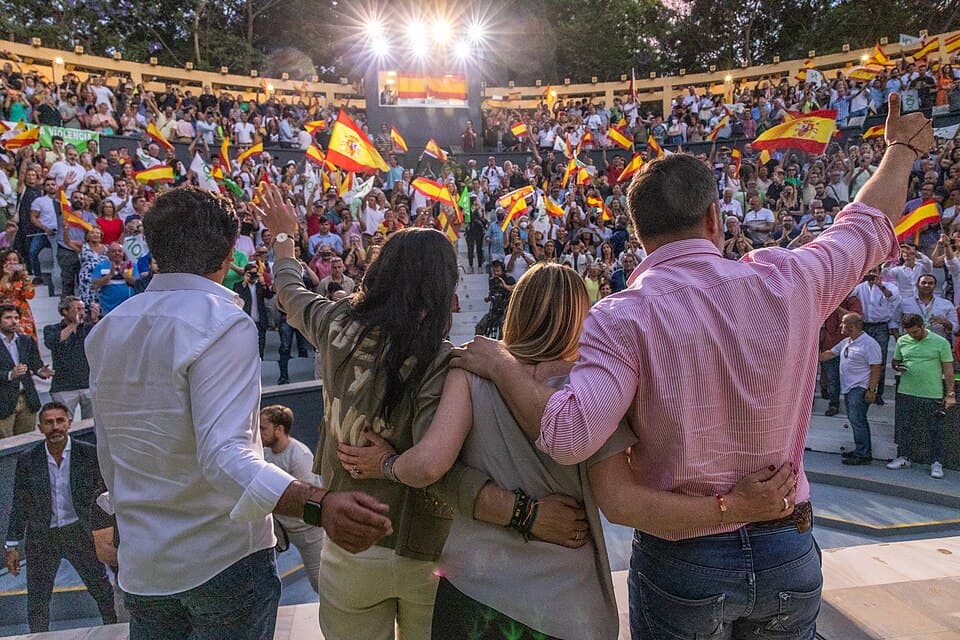
For a year now I've been trying not to read morning newspapers in Spain. It doesn't help. Social media feeds keep throwing politicians' posts at me, anxious threads from strangers, and even from nearby cafe tables I increasingly catch surnames, party names, and the keywords of the moment drifting toward my ear.
A few days ago I came across a post by a fellow Russian noting that Spain's national-conservative party VOX is gaining supporters. What caught my attention wasn't the fact itself, but the reaction. Russians living on the Iberian Peninsula openly welcomed it. "Finally, there will be order in this country," one of them wrote.
Spain is moving rightward. It still resists — the shift seems slower here than in neighboring countries — but it's happening. And there's a sense that people almost apologize for casting their votes for VOX or similar forces. Spanish feminists only recently felt their demands — abortion rights, equal pay, fair working conditions — were being heard. Gay couples gradually began marrying and raising children without fear. And now, before their eyes, a political force is growing that wants to reverse much of it.
"Under Franco this didn't happen." Young Spaniards who never lived under dictatorship are starting to borrow that phrase from older generations. In my country, people say: "Stalin wouldn't have allowed this." The chill is the same.
If Russians invoke Stalin remembering discipline and order, Spaniards invoke Franco out of frustration with what feels like disorder.
Why do people who fled authoritarianism vote for a party that speaks its language?
A Venezuelan friend tells me that many of his compatriots who have long lived in Spain also shout that Spain should belong to Spaniards.
You don't need to be a political scientist to see what fuels the mood: migration, housing prices, strained healthcare, growing tolerance toward issues once culturally taboo. And increasingly, migrants become the convenient culprit.
There is another issue, deeply painful for Spanish people themselves: a hopelessly aging population and a younger generation unwilling to work or reproduce. The reasons are unstable contracts, the impossibility of buying housing, and late separation from parents.
And again, everything circles back to migrants. This time, they are the solution.
The Bank of Spain estimates that immigration accounted for roughly half of the country's post-pandemic GDP growth. Without migrants, growth would have been almost half as strong. This is one of the key arguments used by Prime Minister Pedro Sanchez.
No one has told me to go back where I came from. I haven't faced open hostility. But the feeling that some might think it lingers. And as the political climate shifts rightward, that feeling grows.
Sometimes it seems Spain wants to fix its structural problems with the hands and lives of migrants, while hesitating to recognize them as equal members of society. A passage from Pedro Sanchez in The New York Times left an uneasy aftertaste:
Imagine you are at the helm of a nation facing a significant challenge. Approximately half a million individuals, integral to the daily functioning of society, reside within your borders. They care for our elderly, clean our streets, work in our hospitals, harvest our fields and serve us in bars and hotels. They are also active members of the community, enjoying leisure time in parks, dining out, and participating in local sports leagues.
The language frames migrants in the role of "service personnel," even when the text formally speaks about "protecting their dignity." Even the pro-migration Sanchez sees newcomers as a class of "caregivers" and "cleaners." That is the tragedy. The migrant is necessary to the system, but not necessary as a subject. This is the language of an economist, not the language of citizenship.
It is no surprise that migrants must both accept the role assigned to them and watch anxiously as political forces rise that speak of deportations and revisiting residency and citizenship decisions.
Europe faces a choice: recognize migrants as equals — or continue treating them as instruments. The latter path almost always ends in radicalization.
Is this a long stretch of turbulence? Or is this already the new stability?