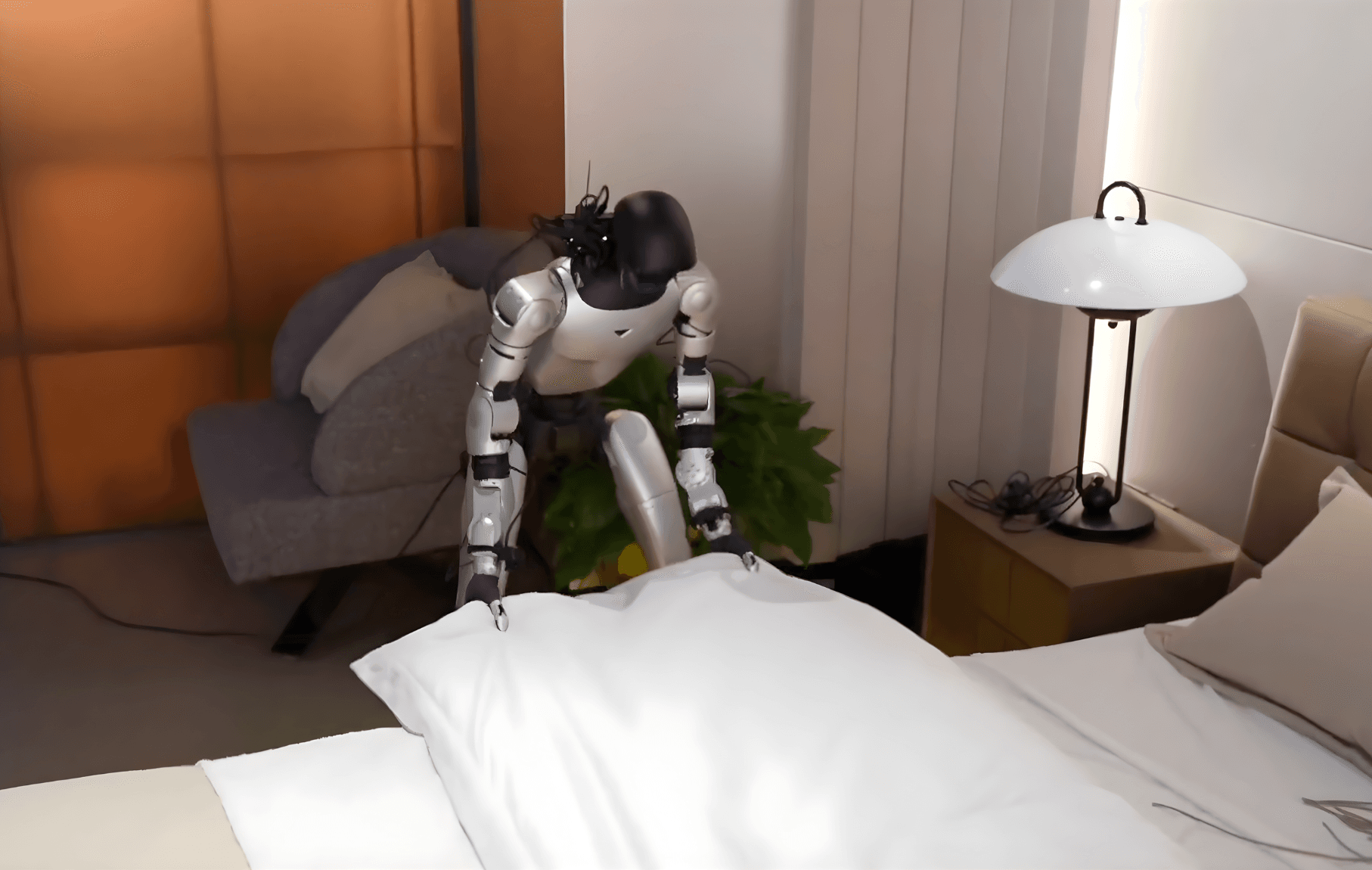
A humanoid robot adds ingredients to dinner with human-like precision, then moves across the kitchen, putting dishes back on the shelves and taking out the trash. At the same time, another robot is making coffee for customers in a cafe. A third appears at the White House beside Melania Trump during a dinner with a group of first ladies. Robots are rapidly moving out of labs and promo videos into everyday life, and they are beginning to compete for a new role: an interface that could eventually take the smartphone's place as the main mediator between people and reality.
The mass market for home humanoid robots has not arrived yet, but the battle for it is already underway. Videos of robots go viral. Companies are selling not just hardware, but a new habit: not tapping a screen, but giving a task by voice. Governments, meanwhile, are thinking about the rules of the game, while Elon Musk presents humanoids as a market that could one day become bigger than the auto industry.
And this is no longer just a question of technology, but of power. China's Unitree sold 5,500 humanoid robots in 2025, while Tesla had not yet sold a single one commercially. Whoever gets this kind of robot into the home first will gain more than a new market. They will gain a chance to place themselves between a person and everyday life.
Will we one day stand in line outside a Robot Shop the way people now wait for the next iPhone? That question already sounds less like fantasy and more like the beginning of a new consumer era.
Key Players
Robots are steadily becoming part of political theater and lobbying infrastructure. We have already seen the first humanoid guest in White House history, accompanying Melania Trump at the Fostering the Future Together summit. Earlier, two Tesla Optimus robots took center stage on Capitol Hill during a bipartisan Robotics Symposium organized by the House Select Committee on China. This is lobbying at the congressional level.
So proud to see F.03 make history as the first humanoid robot in the White House 🤖 🇺🇸 pic.twitter.com/tXsxpEErsi
— Brett Adcock (@adcock_brett) March 25, 2026
In March 2026, senators introduced the American Security Robotics Act, a bill that would ban the U.S. government from purchasing or using Chinese-made humanoid robots for national security purposes. The concern is clear: such machines could collect data, transmit it to China, or serve as instruments of remote control.
Against this backdrop, the Trump administration is also preparing a separate robotics executive order. Commerce Secretary Howard Lutnick has already met with the CEOs of Boston Dynamics, Apptronik, and Figure. The goal is to double American robot production by 2027. Boston Dynamics' long-standing involvement in military contracts is no longer a secret.
The United States' main competitor in this arena is obvious. In its latest Five-Year Plan (2026-2030), China has designated embodied intelligence as a standalone priority. Robots are becoming the connective tissue of the country's modernization: manufacturing, elder care, national security, even culture.
Beijing showcased the physical capabilities of its humanoids during the Spring Festival Gala, China's biggest New Year television event on CCTV. These robots performed flips, reacted to one another, and demonstrated martial arts moves. This is no longer the future.
A fully automated factory in Guangdong rolls out a new robot every 30 minutes. In 2025, China produced 90% of all humanoid robots worldwide.
The U.S. market has yet to take off. As of spring 2026, Tesla had shipped around 150 Optimus units, mostly for internal testing and pilots at its own factories. Figure AI and Agility Robotics were at roughly the same level. Boston Dynamics' Atlas remains in the single digits or low tens, mostly for Hyundai and internal pilots.
America is only now ramping up its production lines. Tesla has started assembling Gen 3 in Fremont, but real mass shipments are expected in 2027 and beyond. For now, the U.S. advantage lies not in hardware sitting in warehouses, but in brains: better integration of LLMs, vision, and reinforcement learning.
This has already become a geopolitical race. In the coming decades, robot sales will become a gold mine, and the market itself may turn out to be for the 21st century what the automobile industry was for the 20th: a source of industrial power, technological leadership, and political weight.
Major Players in the Market
Tesla is Elon Musk's brainchild. For several years he has been repeating the same message: Optimus will become the company's most important product and will eventually turn Tesla from an automaker into the world's largest AI robotics company. Musk himself has said that by the end of 2027 these robots will go on sale to ordinary people, with the long-term price dropping below $20,000. The company is now producing Optimus Gen 3, no longer just a prototype, but a machine capable of walking factory floors, picking up and moving objects, and performing sequential tasks. Tesla's main advantage is its own software, built on the same neural networks as Full Self-Driving: vision, reinforcement learning, and vast datasets from Dojo. For now the robots mostly work inside Tesla facilities, but Musk is unfazed. He believes Optimus will eventually handle everything from factory cleanup to helping around the house.
Optimus will be the biggest product ever made.
— Tesla Optimus (@Tesla_Optimus) March 25, 2026
A general-purpose humanoid robot that can do useful work at scale will change the economics of labor & manufacturing.
Goal is to get Optimus to high-volume production as fast as possible.
If you’re great at AI, engineering, or… pic.twitter.com/4s92onmu2A
Figure AI, a California startup, is making the most home-oriented bet among American companies. Its latest model, Figure 03, launched in October 2025 and was positioned from day one not as a factory worker, but as a home assistant. The robot can fold laundry, wash dishes, water plants, and clear tables, tasks that once seemed too human to automate. At its heart is Helix, Figure's own vision-language-action model, which lets the robot understand natural speech and learn on the fly without custom programming for every task. The official price has not been announced, but insiders say the target is around $20,000, the sweet spot where a robot stops being a billionaire's toy and becomes a mass-market product.
Boston Dynamics is a legend now pivoting toward the real market. Its new fully electric Atlas, unveiled at CES in January 2026, no longer does backflips for viral videos. It is built for heavy industry. The robot can lift 30-50 kg, operate in extreme heat and cold, and even change its own batteries. Atlas is already being piloted at Hyundai plants and in projects with Google DeepMind. The price remains undisclosed, but market estimates put it between $150,000 and $320,000 per unit. This is not mass-market hardware. It is heavy artillery for tough industrial environments.
Agility Robotics was the first American company to launch a dedicated humanoid robot factory in Oregon, RoboFab. Its Digit is already working in Amazon warehouses and other logistics giants. Designed specifically for human-built spaces, it climbs ramps, carries boxes, and navigates tight aisles. Standing roughly 175 cm tall with a 16 kg payload and up to four hours of runtime, Digit is priced between $100,000 and $250,000 in pilot projects. Agility is not chasing the smartest AI. It bets on practicality and scale. Its robot is already earning real money in real warehouses.
Now China.
🚀 Unitree open-sources UnifoLM-WBT-Dataset — a high-quality real-world humanoid robot whole-body teleoperation (WBT) dataset for open environments.
— Unitree (@UnitreeRobotics) March 27, 2026
🥳Publicly available since March 5, 2026, the dataset will continue to receive high-frequency rolling updates. It aims to establish… pic.twitter.com/nBbB0XJLix
Unitree Robotics is China's "people's champion," the company that shattered the market with aggressive pricing. Its G1 model starts at $13,000-$16,000, while the brand-new R1 goes for as little as $5,900. These are no longer lab toys: they walk, run, perform basic manipulations, and even pull off acrobatics. Unitree sells actively to developers, universities, and experimenters. The software is open, supports Python and ROS, and includes the company's own AI modules. The bet is simple: accessibility. While Tesla and Figure aim for $20,000, Unitree is already there and going lower.
AgiBot (AGIBOT Innovation) is currently the undisputed volume champion. In 2025 alone it delivered over 5,000 robots, and by March 2026 it had already surpassed 10,000 units. Its A2 series consists of industrial humanoids about 170 cm tall with more than 40 degrees of freedom, deployed in factories, logistics, and even entertainment. Prices range from $100,000 to $190,000 depending on configuration. AgiBot is not trying to be the smartest. It simply builds them fast, cheap, and in huge numbers, fully leveraging China's supply chain.
UBTECH Robotics is another Chinese heavyweight that has held its ground for years. Orders for its Walker S2 and new home models have already reached hundreds of millions of dollars. UBTECH is targeting both industry and companion robots simultaneously, with a $20,000 version planned for the mass market. Its machines interact with people, work in service roles, and are increasingly entering government projects. Research models start at $41,000, but the company openly aims to drop below $20,000 by 2027-2030.
Robots Are Coming
Robots that dance, clean houses, cook meals, and work in warehouses, the kind of science fiction we were reading in books just 10-15 years ago, have now become everyday reality. What's more, robots are emerging as a new interface that directly competes with smartphones. If the phone screen acts as a mediator between a person and the digital world, then a robot is an interface that brings that digital world into physical space and becomes the mediator between a person and the environment around them.
Chinese startup MindOn in Shenzhen dropped a demo of their "robot brain".
— Rohan Paul (@rohanpaul_ai) April 1, 2026
Watch it autonomously water plants, open curtains, tidy rooms and carry packages & clean.
MindOn's world model turns the Unitree G1 into an independent chore bot. pic.twitter.com/JNU7KEbrcf
There is no doubt that this device also gives its owner a special status, one that signals not only wealth, but the ability to value time and live "ahead of the curve." Call it a classic marketing slogan if you like.
Just as Tesla was never merely a car brand, but a symbol of belonging to the future, a home robot will become the marker of a new domestic elite.
A robot will be sold not only as a practical helper, but as an emotionally charged product that creates a sense of magic, the feeling that the technology is truly alive. It will feed the illusion of stepping into a higher level of life. If the iPhone once said, "I live in the modern world," the robot will say, "I live in the next version of the world." And that is precisely why robots, like smartphones before them, will be bought not just for their technical specifications and capabilities.
I would even suggest that Tesla and other American manufacturers are deliberately holding back on mass production. They are counting on the classic iPhone effect: for many buyers, brand prestige and the aura of the product matter more than raw functionality.
It is quite possible that the United States is currently allowing China to surge ahead in production volume, planning to reclaim the market later through superior branding, software, and prestige.
New models will be launched as major events: strategic leaks of "secret" information to the media, rumors about upcoming software updates, and plenty of pre-hype from excited bloggers and influencers. Then come pre-orders, massive buzz, and people lining up overnight outside stores. And unlike a smartphone, the robot will be updated not only as a device, but as behavior. New software will literally mean new actions and new skills inside your home.
Why the Robot Market Is Gaining Geopolitical Importance
Up until now, car manufacturing has been a major source of national income, and car brands have become powerful symbols of technological progress, reliability, and trust. When we hear "Japan," "United States," "Germany," or now "China," we instantly picture specific automotive brands. The auto industry has allowed these countries to project strength and speak with greater weight on the world stage.
Robotics is now following the same path and is quickly becoming one of the key industrial giants of our time. It features complex supply chains, expensive core components, mass production, after-sales service, and continuous software updates, almost exactly like the automotive industry.
The forecasts already hint at the scale: according to various estimates, the humanoid robot market could grow from just a few billion dollars today to $15.26 billion by 2030, while the broader robotics market could reach tens or even hundreds of billions.
Not everyone will be able to welcome a robot into their home, at least not in the early years. The biggest barrier is the price of the device itself. On top of that, owners will have to pay for advanced features. Imagine a robot with nurse-level skills that can make a basic diagnosis, issue a sick leave note, and prescribe simple medication, almost like medical insurance. Paid add-ons will also include erotic functions and other premium capabilities, such as the skills of an Italian chef. And do not forget cloud storage. In short, a robot will mean additional monthly expenses on top of the subscriptions we already pay for our smartphones and internet.
Apps for Robots
Robots are developing their own platform layer. Robotics already rests on a solid foundational stack: the open-source ROS, or Robot Operating System, and commercial platforms such as NVIDIA Isaac. Isaac gives developers simulation environments, libraries, AI models, and toolkits for training and deploying robots. NVIDIA markets it as a full-stack platform for autonomous mobile robots, manipulators, and humanoids, while Isaac ROS is built directly on ROS 2.
Just as with Android and iOS, robotics is moving toward platforms where skills, behaviors, integrations, and specialized applications will be built. The software layer here is far more complex, which means entirely new skills, professions, jobs, and even dedicated teams are about to emerge. Unless, of course, that work itself gets outsourced to other robots.
In any case, the new field of robot app development is already taking off. Developers will no longer simply build apps. They will create robot skills: kitchen routines, home-care scenarios, restaurant workflows, smart-home integrations, and vertical-specific workflows. This will be significantly more expensive and technically demanding than mobile or web development.
We are no longer talking about frontend plus backend. This requires AI and multimodal models, robotics middleware, computer vision, motion planning, simulation, safety systems, and hybrid cloud-plus-edge deployment.
The home robot market is not just a battle between hardware manufacturers. It is also shaping up to be a fight for the platform itself: whose operating system becomes the standard? Whose SDKs will developers adopt? Who will control the marketplace of skills? Who will take a cut of robot software? And who will become the Android or iOS of the physical AI era?
If the smartphone created the mobile app economy, the home robot may create the economy of applied behavior.