
The world is holding its breath before a December detonation — the release of the Epstein Files. In November, Trump signed the order that blasted through Congress almost unanimously. The political class pretended this was all “business as usual,” but the fear was visible. Too much had already leaked: letters, flight logs, private archives, photos from Epstein’s mansions, survivor testimonies.
Ghislaine Maxwell is in prison. Virginia Giuffre is dead. Her posthumous book Nobody’s Girl, published in October, tears open the membrane between the “official version” and the stench the elite spent decades trying to bury.
The scandal scorches everyone — Democrats, Republicans, billionaires, prime ministers. And, of course, the sitting U.S. president, who suddenly finds himself at the center of a story that could very well end in impeachment.
Trump’s Motives — Why He Pulled the Pin
The Epstein scandal isn’t a leak — it’s an X-ray. And what it shows is a political elite rotted through: prosecutors, presidents, billionaires, academic idols — all those who spent years covering for each other while children were turned into disposable material.
If this were just about luxury and bored decadence, fine. But it’s not. It’s about people who crossed every moral boundary and built exploitation into their political and economic ecosystem.
Against that backdrop, ordinary workers, undocumented migrants, the homeless, kids from poor neighborhoods look cleaner than the presidents they elect and the corporate bosses they work for. Because one photo, one flight log, one line in Epstein’s damn books isn’t a mark of shame — it’s a diagnosis. Chronic.
Honestly, I never thought Trump would be the one to push for the release of the files. At best, I expected a veto. Yet he signed it. Why?
The obvious answer: he was cornered. The leaks kept coming, media and social networks were screaming release the files, investigators were digging, and the MAGA movement started cracking. Republicans stalled the bill under the banner of “protecting victim privacy,” but the breach came from Marjorie Taylor Greene. She pulled the pin in public:
I don’t worship Donald Trump… I remain America First.
The clash with Trump ended with MTG leaving the party entirely. What’s left of the movement split into “loyalty dogs” and “truth fighters.” Trump’s approval among Republicans dropped 12%, according to Gallup on November 23.
The political air thickened. And Trump had to move — or his own base would have torn him apart.
Ricochet Through the Republicans
At first glance it might seem that Trump, out of sheer desperation, decided to drag everyone mentioned in the Epstein files straight into the abyss with him.
Or that his disclosure act was a heavy, deliberate signal to his allies—including those in hostile factions—to close ranks and save their own skins.
But the reality is simpler: both Republicans and Democrats already have real cases on their hands—police investigations, congressional probes—and more are clearly on the way.
A defining stroke in the portrait of Trump’s inner circle is the story of Congressman Matt Gaetz. In 2024 he was expecting to become Attorney General in a future Trump administration—and exactly at that moment the FBI probe connected to his long-time associate Joel Greenberg resurfaced. Greenberg, a former Florida tax official, served 11 years after being convicted of exploiting a 17-year-old.
In court he admitted paying an underage girl from a group home and organizing small “pools” of introductions using Venmo payments and a network of acquaintances. Case files included transfers he made “in tandem” with Gaetz—which automatically pulled the congressman into the orbit of the investigation.
Gaetz denied everything, and the Justice Department eventually closed the case for lack of direct evidence. But the background remained. The very fact that a man with such baggage seriously aimed for the top law-enforcement post in the country is telling—and fits perfectly into the same pattern that runs through the Epstein saga.
Another stroke in this picture is Roy Cohn. Although he died of AIDS in 1986, the story of his relationship with Trump still raises questions. American media described Cohn as a “crooked New York lawyer” and “the personification of evil.” He wasn’t merely Trump’s attorney—he was the architect of the political culture in which young Trump was shaped.
Cohn is considered Trump’s mentor because it was he who handed him the full arsenal of tactics the former president still uses today: strike first, deny everything, attack the press, never apologize.
But it matters who this teacher was himself. Cohn spent decades inside the darkest core of New York’s elite. He was simultaneously the prosecutor who sent the Rosenbergs to the electric chair, McCarthy’s right hand, a mafia lawyer, a political fixer, a Studio 54 regular, a man who would call newspaper editors and dictate headlines.
In the documentary Where’s My Roy Cohn?—the same one quoted by The New Republic—every interviewee repeats the same line:
Everybody knew.
Everyone knew that Cohn surrounded himself with young, handsome men; everyone knew about his nightlife—Studio 54, the constant hunt for sex, the endless parties.
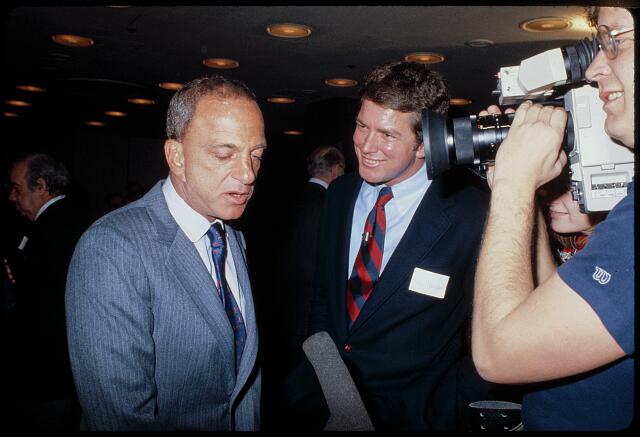
Roy Cohn — the architect of New York’s darkest political culture and Trump’s earliest mentor. Library of Congress, Prints & Photographs Division.
Everyone knew he was a monster—and they stayed close to him anyway.
If this entire story has a dark connective tissue, one of its strands is Alan Dershowitz. Dershowitz is one of the most famous lawyers in the United States—a Harvard professor, a star of American courtroom culture, an author of dozens of books. And that’s exactly why his persistent presence in the Epstein orbit feels so sticky.
Here are the facts that matter. His name appeared in a civil lawsuit filed by Virginia Giuffre. Giuffre later retracted her accusations—and that is important to note. Dershowitz publicly denied everything and filed a countersuit. He acknowledged that he knew Epstein, visited his homes, and consulted him. His name appears in several flight logs.
Taken together, these details show the scale: Epstein wasn’t just adjacent to the elite—he was woven into it far deeper than most people want to admit.
Roger Stone is another thread in this pattern. He wasn’t charged in the Epstein case, but he appears across connective lists and draft log-lists, in the context of shared circles and communication chains. And his significance lies not in “what he did,” but where he stands in the ecosystem. In 2019, Stone was convicted on seven counts—obstruction, lying to Congress, and witness tampering in the Mueller investigation. In 2020, Trump commuted his sentence—essentially pulling him out of prison and turning the case into a political pledge of loyalty.
Stone is a graduate of the Roy Cohn school: the same manual—strike first, deny everything, stall, call the investigation a witch hunt.
By 2025, he appears on Newsmax confidently declaring that “the Epstein docs clear Trump’s name”, an attempt to pre-launder the boss before the public even sees the scale of what’s coming.
Democrats, Brace Yourselves
The Lolita Express flight logs hit the Democrats just as hard—in some places even harder—than they hit Trump. Several of their own are now getting roasted by the media more aggressively than the former president. Their ties to Epstein run deeper, older, and are documented far more densely than they have ever been willing to admit.
The Clinton story isn’t rumor. It’s in the official aviation records. Reporters who analyzed the documents available as of late November 2025 found that the former president took at least 26 flights aboard Epstein’s Boeing 727 between 2001 and 2003. Hong Kong, Japan, Singapore, China, Norway, Belgium, the Azores, Africa—and, crucially, Russia. Some of those flights included full Secret Service protection. But, tellingly, not all.
On May 20, 2002, Epstein picked up Clinton in Novosibirsk—a Siberian city far off any standard diplomatic itinerary—and flew him to the U.S. Naval base in Atsugi, Japan. The manifest lists: Bill Clinton, Ghislaine Maxwell, Sarah Kellen, pilot Rodgers. Missing entirely: Secret Service agents.
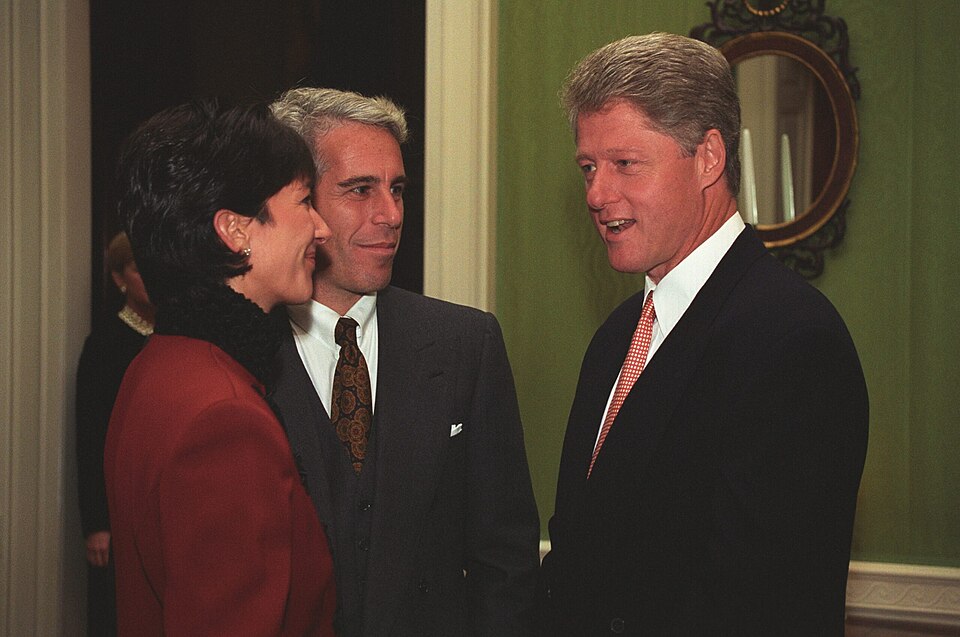
Photographed by White House photographer Ralph Alswang on September 29, 1993. Jeffrey Epstein and Ghislaine Maxwell speaking with President Bill Clinton during an event for donors to the White House restoration project. Image courtesy of the William J. Clinton Presidential Library and Museum (public domain).
This is one of five flights where Clinton’s security detail isn’t recorded at all—a complete break from established presidential travel protocol.
Clinton denied for years. But cold, digitized logs don’t care about denials—they revive memories on their own.
Another heavyweight emerging from the Epstein Files is Larry Summers—former Treasury Secretary under Clinton and former president of Harvard. In November 2025, Summers abruptly stepped down from the OpenAI board. The official line was “board rebalance.” His voluntary resignation happened to coincide with the release of a new tranche of files—and social media exploded with #SummersShame.
What surfaced was uncomfortable: Summers maintained a friendship with Epstein even after his conviction, and in emails sought Epstein’s “friendly advice” on what to do in certain intimate situations—the infamous “getting horizontal with her.” His sexist jokes and the fact that he referred to Epstein as his “wingman” also became public.
Summers is not charged with any crime, but his case is the perfect illustration of how Epstein bought influence through “research,” “grants,” philanthropy, and the VIP Harvard/MIT network.
Inside all this criminal muck, another name appears: Reid Hoffman—billionaire, LinkedIn co-founder, and one of the biggest donors to Biden and Harris. Hoffman openly admitted that he visited Epstein’s Manhattan townhouse several times after Epstein’s 2008 conviction, calling those visits “a mistake in judgment.” But the word “mistake” becomes questionable when you add everything else.
He flew on the Lolita jet twice in 2002—this is documented in the flight logs. Victims mentioned him in their testimonies as someone who appeared at the “model parties.” He also invested in Epstein-linked projects and donated millions to the Clinton Foundation.
The shadow of dead Epstein stretches across both major American parties. And the polling reflects it: half of Americans believe both parties took part in burying the files. A portion of respondents go even further, naming Clinton as the possible “main roadblock” to full disclosure.
What Exactly Exists on Trump
Trump opened the door to the Epstein Files, and the light spilled into a room where a man resembling him sits at a desk, sketching the silhouette of a naked woman with the signature “Donald” placed where the lower triangle should be. “May every day be another wonderful secret,”—that’s how he allegedly signed a postcard to Epstein, the one that triggered Trump’s $10 billion lawsuit against the Wall Street Journal, which he called a fake. But the very existence of that postcard fits the atmosphere of that entire era a little too well.
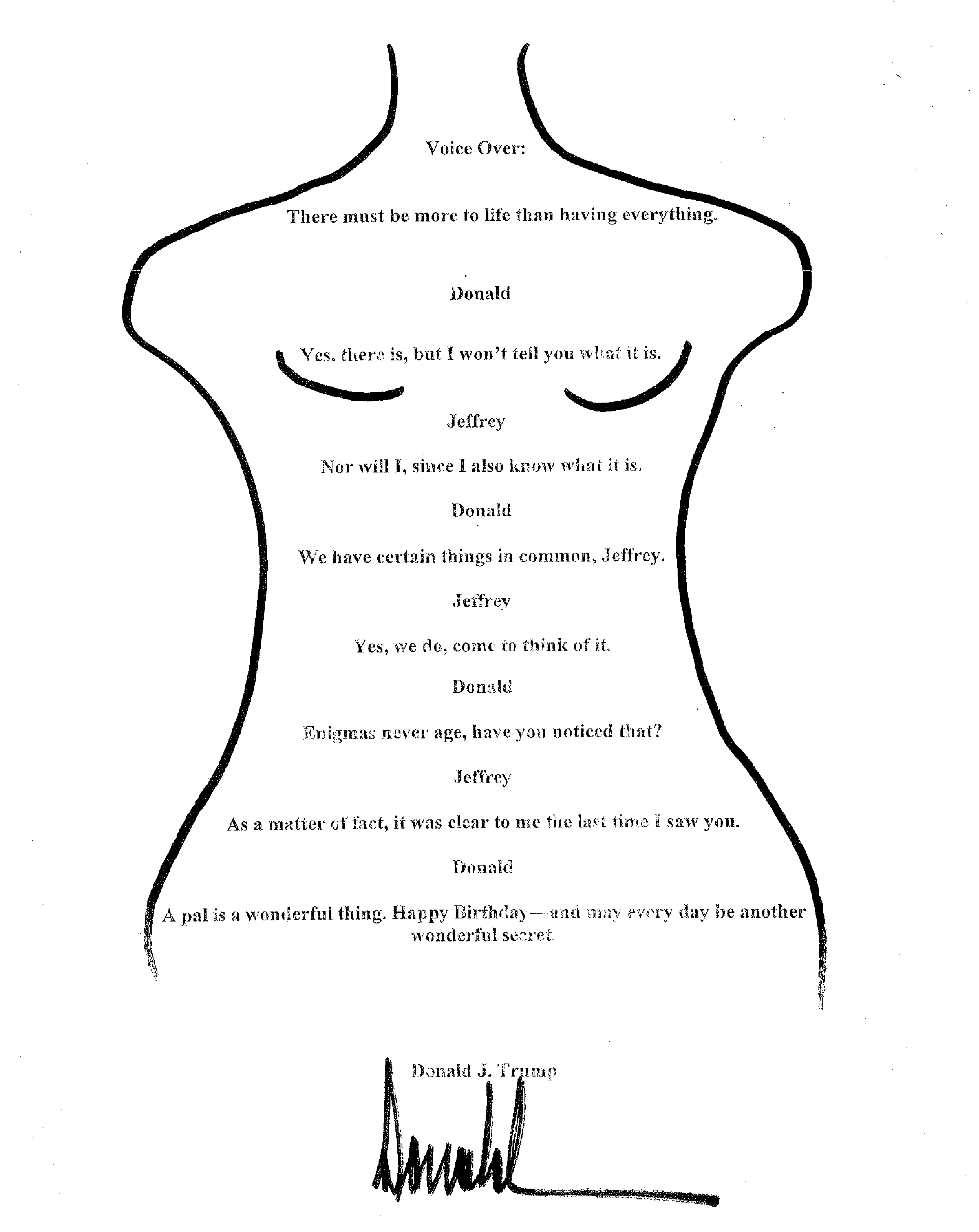
The birthday note Trump insists ‘doesn’t exist.’ Released by Oversight Democrats, it reads: ‘May every day be another wonderful secret.’ If this was the secret he shared with Epstein, the public deserves to know.
In Epstein’s logs, Trump doesn’t appear as a random passenger. He appears as someone who, in the 1990s and early 2000s, lived in the same social ecosystem: parties, models, clubs, late-night donor events.
Seven Trump flights on Epstein’s jet are documented. Routes: New York, Palm Beach. And yes, his public claim that he flew “once, with my son” looks clumsy next to official records and resurfaced emails: “Donald knew about the girls at the parties, spent hours with [victim], but smart—never touches when cameras.”
In 2002, Trump himself gave the quote that now reads like an epitaph for the entire era: “Terrific guy… likes beautiful women—many of them on the younger side.” Back then it sounded like casual locker-room talk between two men with identical tastes in club nightlife. Today it’s a marker of a world most people would prefer to erase.
The archives only deepen the sense of stickiness. In NBC’s 1992 VHS tapes, they’re at a Mar-a-Lago party together, laughing, gesturing toward the “younger side,” performing those classic “alpha-rooster” moves of the 90s.
In 1993, Epstein sits at Trump’s wedding to Marla Maples in the front row beside Ghislaine Maxwell. There are photos from the late-90s Harley Davidson Cafe where they appear together in the company of a group of young models. Photographers, society pages, and tabloids of that time treated it not as suspicious, but simply as “the usual atmosphere.”
In the November 2025 dumps, an exchange between Epstein and Maxwell discusses “old VHS tapes from Mar-a-Lago.” One line mentions that Trump “flirted with young models”, parts of the messages are redacted, but the very fact these materials exist is now a topic in Congress. Bondi, in July 2025, admitted that the FBI holds tens of thousands of old videotapes recovered from Palm Beach storage.
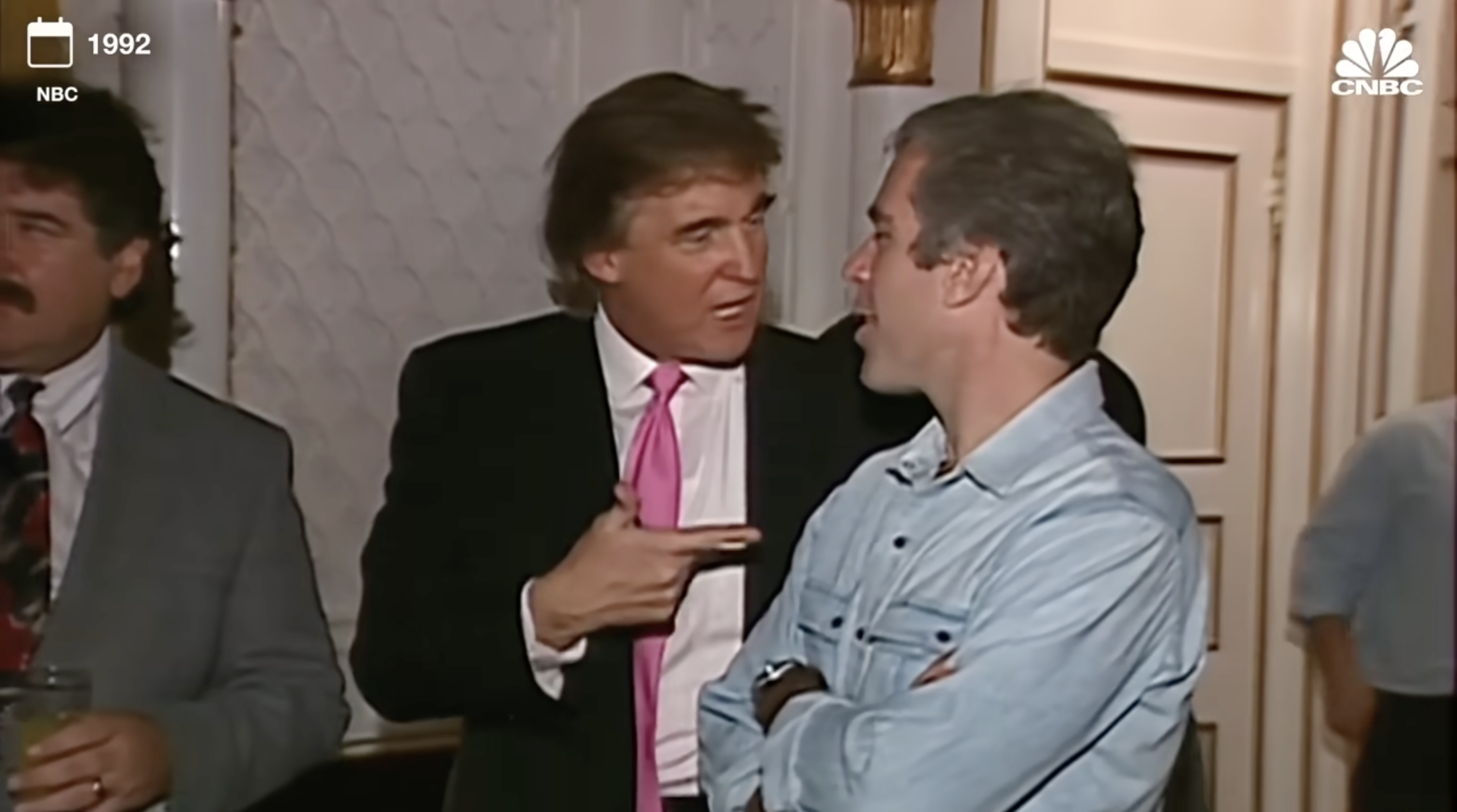
Trump and Epstein at Mar-a-Lago, 1992 — captured by NBC. A glimpse into the social ecosystem they shared long before the flight logs, letters, and sealed archives turned into a national reckoning
There was a later moment when Trump banned Epstein from Mar-a-Lago, after Epstein “recruited a girl” from the club’s spa. But before that—there were years of overlap, shared parties, shared invitations, shared circles.
Trump intended to blow up the Democrats—Clinton with his twenty-six flights and that strange Asian route, Summers with his “getting horizontal,” Hoffman with his “mistaken visits.” But the fire spread backwards.
How the Girls Were Pulled Into Epstein’s Network
Epstein’s machine worked in the cruelest possible way: it hunted those who were trying to crawl out of misery. His victims weren’t professional models or social-media starlets. They were ordinary teenagers, the poor, the vulnerable, the ones already standing at the edge.
Most of the girls came from unstable homes or lived in group shelters. They worked wherever they could, clung to any promise that sounded like a way out. They trusted adults who told them they were being offered “a chance”: a career, money for school, help for their families. Every one of them thought, “Maybe this is my exit.” That childlike hope—and the hunger behind it—was exactly what the system preyed on.
Survivors all describe the same root truth: none of them ended up there from a position of power. They came from need.
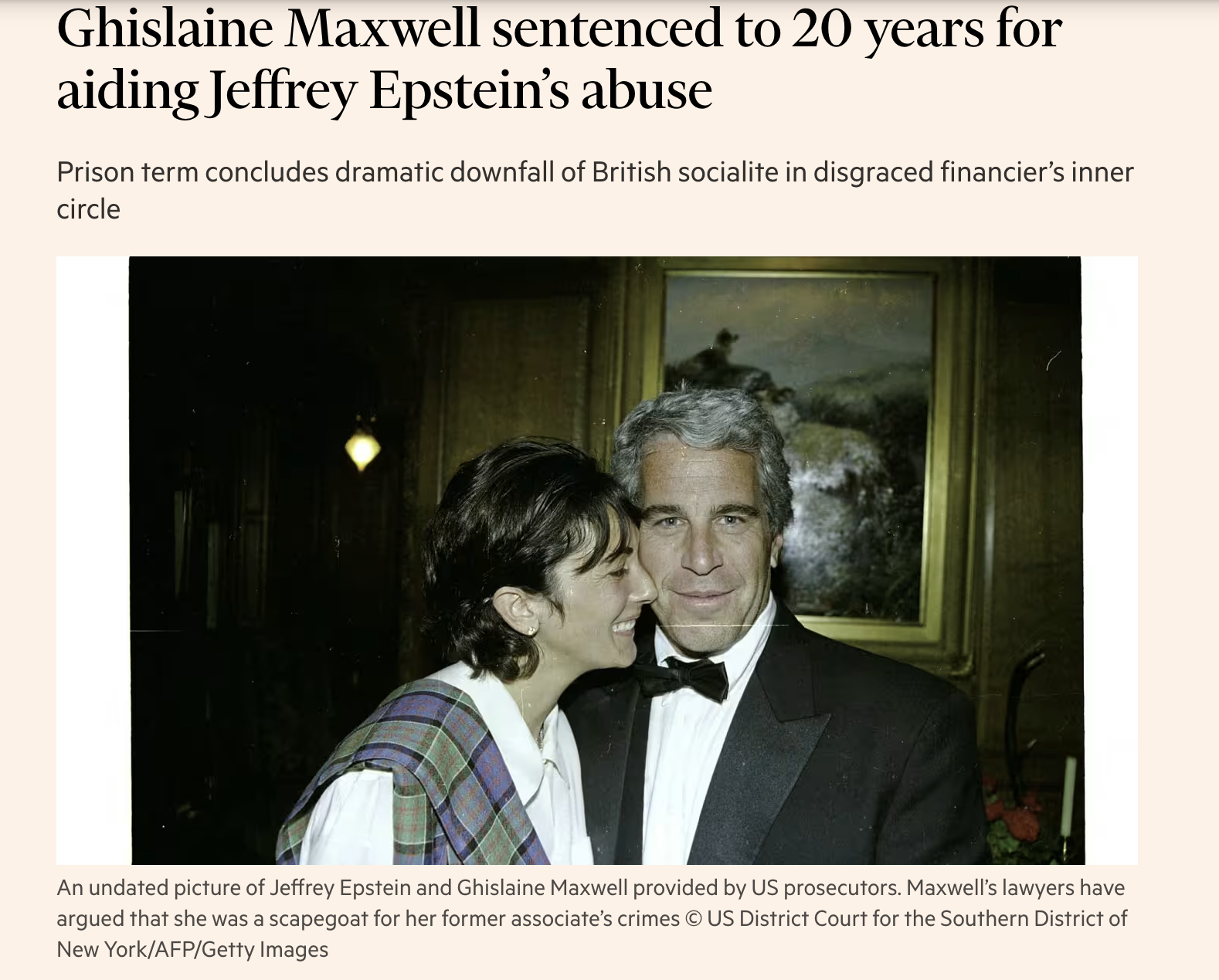
Screenshot from a Financial Times article on Ghislaine Maxwell’s sentencing. A glimpse into the partnership at the core of Epstein’s inner circle — the network that prosecutors say enabled two decades of systemic exploitation.
Ghislaine Maxwell was called “the socialite madam,” but what she really did was simple and brutal: she targeted those who could not say “no,” because no one had ever given them anything to say “yes” to.
Their testimonies describe a structure built on control—emotional, financial, and social. The pattern repeated again and again. Older women approached them first: friends, assistants, recruiters. The dream was wrapped beautifully—a massage job, model castings, access to wealthy patrons. Behind that came dependency, fast and suffocating. A choice that wasn’t a choice: keep doing this, or fall straight back into poverty.
There is one word that appears again and again in the victims’ testimonies: trapped.
Virginia Giuffre (listed in the documents as Roberts) became the symbol of this circle. Her story is not about “parties.” It’s about a girl looking for help who ended up caught inside a global machine built by the powerful.
Lolita Express
The name “Lolita Express” wasn’t born on forums or in tabloids. It came from the inside—from pilots, mechanics, reporters, investigators. It stuck within the system because what happened on board looked too much like a Nabokov metaphor pushed into a darker, real-world form.
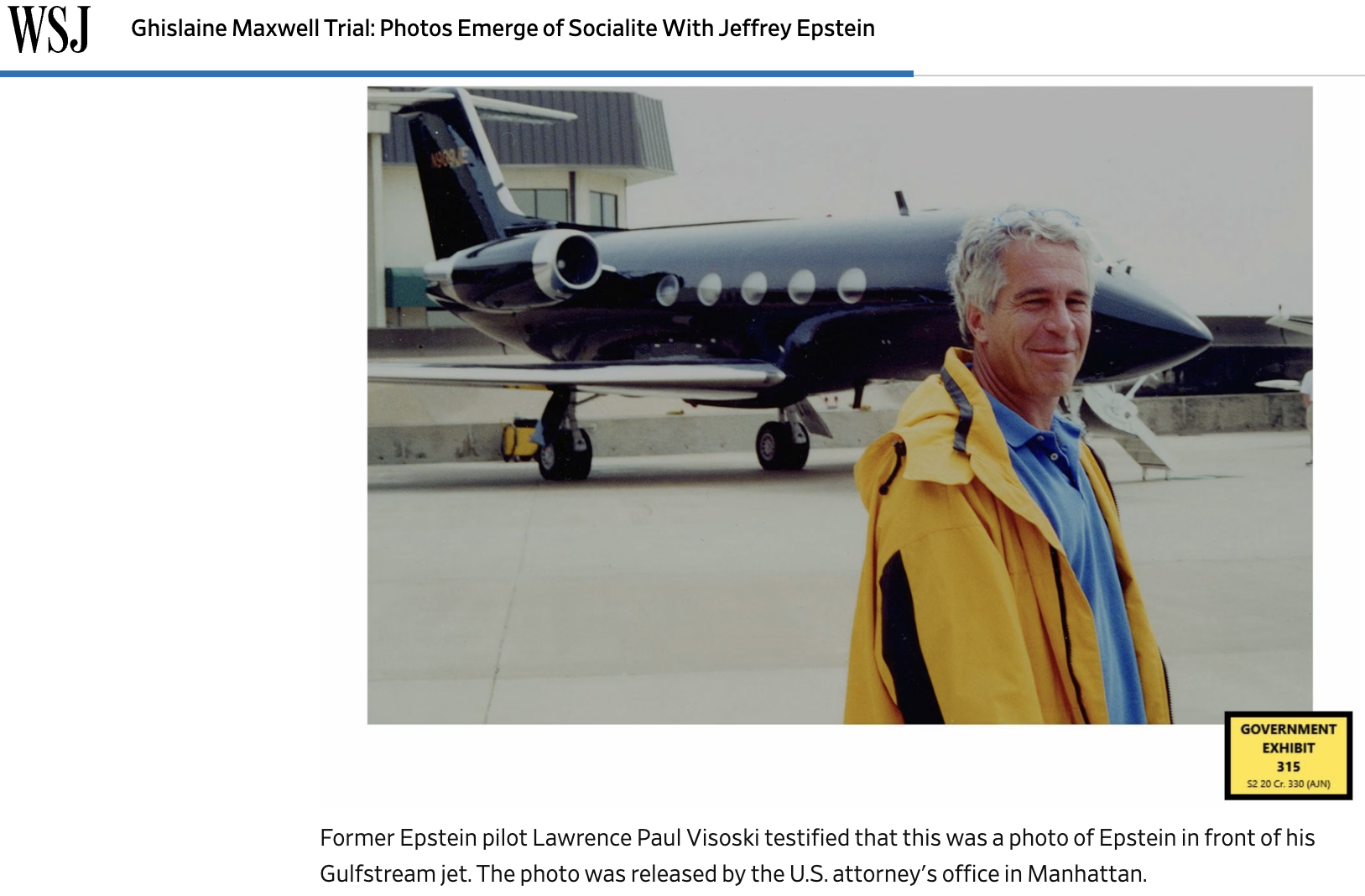
Jeffrey Epstein standing beside his Gulfstream jet. The image was introduced as Government Exhibit 315 during the Maxwell trial and released by the U.S. attorney’s office in Manhattan. Former pilot Lawrence Paul Visoski testified that this aircraft was part of Epstein’s regular travel network
Technically, it was just a Boeing 727. In practice, it was a flying private club pushed to the edge of obscenity. Sound-proofed interiors. Partitioned, closed-off areas. A bedroom built into the tail section, arranged so no one could glance inside unless invited. A setup impossible to explain as “business-travel comfort.”
The crew saw more than they were ever supposed to. Journalists saw the passenger lists. Investigators saw the manifests.
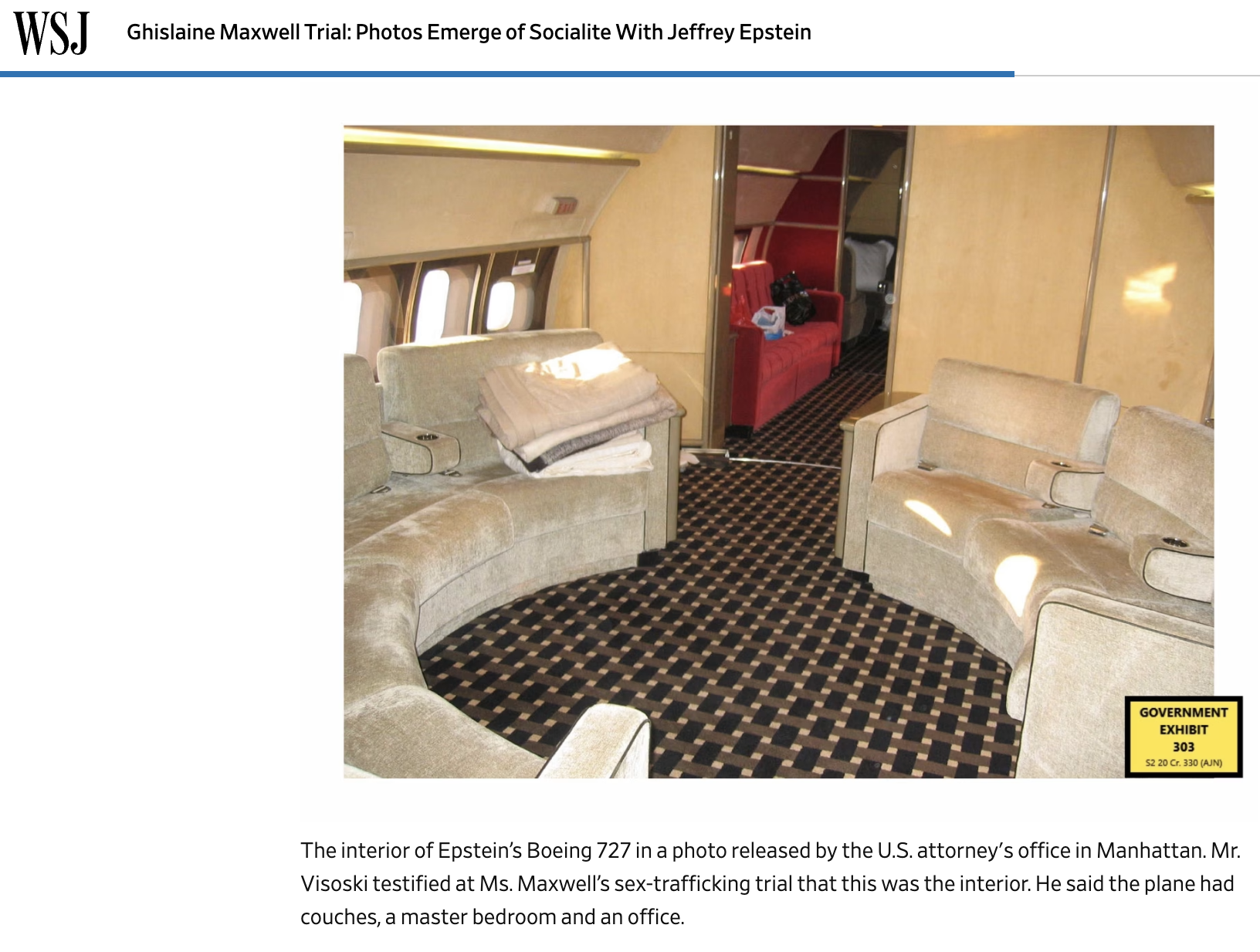
Interior of Epstein’s Boeing 727, shown as Government Exhibit 303 during the Maxwell trial. According to pilot Lawrence Visoski’s testimony, the aircraft featured a master bedroom, lounge areas, and a private office — details that later contributed to the plane’s notoriety in press accounts.
And there, among businessmen, politicians, wealthy patrons, social celebrities, and media figures—teenage girls appeared again and again.
It was this combination—elite passengers + closed rooms + underage girls + a host already notorious for his “massage” stories—that created the association the press would never shake off.
The Nabokov reference was inevitable. Except what happened on that plane wasn’t a literary metaphor. It was a service station for the darkest fantasies of powerful men.
Pam Bondi: the woman sent to keep the lid on the sarcophagus
When the Epstein files started leaking into the open, the White House pushed Pam Bondi to the front—the former Florida Attorney General known not for accelerating investigations, but for stopping them.
This wasn’t a random staffing choice; it was political engineering: put a gatekeeper in place who knows how to stall, slow-roll, and bury documents under the label “ongoing investigation.”
Bondi instantly reverted to the strategy she had used in every major case before.
Create a bureaucratic smoke screen. References to “review,” “internal assessment,” “legal risks.” Signal that releasing the material is a “complex legal procedure.”
Delay everything through formal requests. New committees, subcommittees, working groups. Every press inquiry—“under evaluation.” Every Congressional demand—“our attorneys are reviewing.”
Choke the leaks. Smile in public and promise transparency; behind the scenes—gather documents into locked bundles, route them through agencies, control every outgoing line of information.
But reality slipped out of her hands faster than she could issue press releases.
Leaks came in waves: flight logs, letters, video tapes, internal emails, pilot testimony, FBI material. Journalists got access to scanned documents before committees even read them.
And the moment was lost.
What Bondi tried to keep sealed burst into the public sphere like gas escaping a cracked tank.
And now the landscape looks like this:
- Congress demanding full disclosure.
- Courts setting accelerated timelines.
- Media publishing documents in batches.
- Survivors demanding protection.
- Politicians selling each other out to save themselves.
Bondi became the person tasked with holding down the lid of a sarcophagus, but the sarcophagus split open before she even reached for the tools.
Her role turned into a symbol: the authorities no longer control this process. What began as a political maneuver has collapsed into an unstoppable landslide.