Trump has left Beijing. Before boarding Air Force One, White House staff collected the badges, burner phones, and Chinese-issued pins from the delegation and threw them straight into a trash bin at the foot of the stairs. The visit was over.
But this summit is already sending ripples across the world. Everyone is looking for answers: what happens now to the Middle East conflict, energy prices, and the new geopolitical balance?
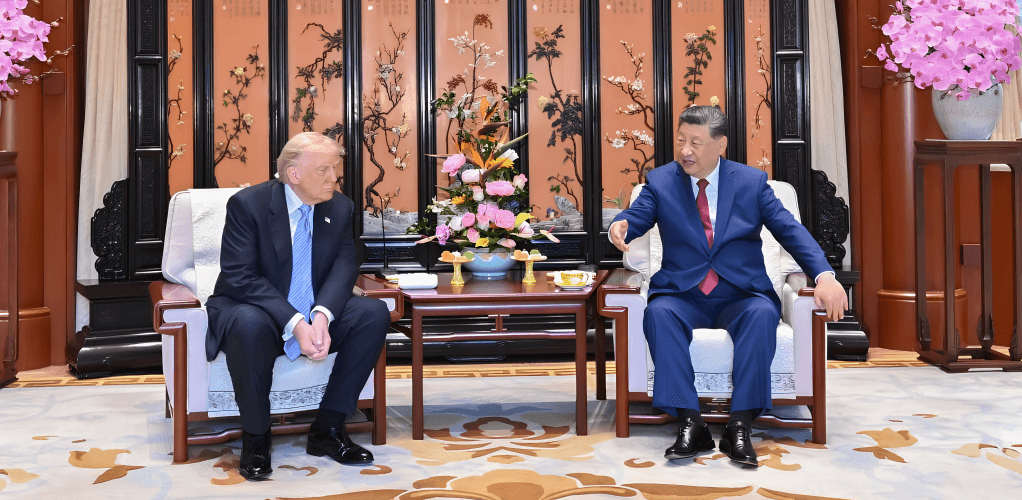
Trump's diplomacy is eloquent compliments, a delegation packed with stars from the tech and financial worlds, and performative courtesy. Xi's style is impeccable protocol, maximum confidentiality, and a language of gestures, hints, and symbols. At meetings like this, where the real substance stays behind closed doors, protocol and body language become the main text.
The composition of the American delegation made one thing immediately obvious: Trump came to impress Xi with American power and offer a "great deal." Beijing could help Washington with Iran, with purchases of American technology, and with agricultural products. Xi showed he was open to dialogue. The reception was lavish: military honors, a red carpet, an orchestra. But everything was strictly ceremonial and under the hosts' total control.
On the very first day it became clear at what level Beijing was willing to negotiate. And that level is called Taiwan.
The Chinese Foreign Ministry's official readout put the position bluntly:
President Xi stressed that the Taiwan question is the most important issue in China-U.S. relations. If it is handled properly, the bilateral relationship will enjoy overall stability. Otherwise, the two countries will have clashes and even conflicts, putting the entire relationship in great jeopardy. "Taiwan independence" and cross-Strait peace are as irreconcilable as fire and water. Safeguarding peace and stability across the Taiwan Strait is the biggest common denominator between China and the U.S. The U.S. side must exercise extra caution in handling the Taiwan question.
Beijing had already drawn its four red lines before the summit. During the meeting itself, Xi put the main one, Taiwan, front and center. At that point, the summit could have ended.
But there was still the palace tour, the garden walk, the state banquet, the joint photos, and the tea ceremony. Trump had to stay until the end. Because he cannot sell Taiwan.
Taiwan, the Fault Line
Over the past 10 to 12 years, Taiwan has stopped being a "technical issue." It has become a symbol: the symbol of a noisy, open democracy defeating an authoritarian system. Add to that TSMC, which produces 90 percent of the world's most advanced semiconductors. Giving up Taiwan means handing China control over the future of AI, weapons systems, and the entire technology supply chain.
On this issue, American politics shows total unity: Democrats and Republicans alike. Because Taiwan is no longer about geopolitics. It is about American identity: "If we sell Taiwan, then what exactly are we defending?"
That is why even if Trump showed transactional softness in private, he will never confirm it publicly. Selling Taiwan would be the end of his political career and a betrayal of his own myth of "strong America."
In fact, Taiwan was the only issue during the entire visit where Trump dodged a direct answer. "China is beautiful," he said. And just a few hours after the meeting, Secretary of State Marco Rubio, speaking from Beijing in an NBC News interview, drew the line:
U.S. policy on the issue of Taiwan is unchanged as of today and as of the meeting that we had here today. They always raise it on their side. We always make clear our position, and we move on to the other topics.
He added sharply: any attempt by China to take Taiwan by force would be a "terrible mistake."
Trump can feed Xi as many pretty words and business deals as he wants. The archetype of freedom is stronger than any deal.
Aboard Air Force One on the way back to Washington, Trump told reporters how the Taiwan conversation actually went.
We talked a lot about Taiwan. Xi does not want to see a fight for independence... I didn't make a comment on it. I heard him out.
When asked about arms sales to Taiwan, he was evasive:
I will make a determination over the next fairly short period.
And about Xi's historical view, he added:
He said, "We've had it for thousands of years and then at a certain period of time it left and we're going to get it back." On Taiwan he feels very strongly. I made no commitment either way.
High above the Pacific, Trump made it clear: no firm promises. Neither yes nor no. Only "I heard him" and "I'll decide later."
China, for its part, made it crystal clear: it would like economic and technological cooperation with the United States, but it does not particularly need it.
The Boeing contract turned out far more modest than Washington had hoped. Instead of the expected 750 planes, Beijing agreed to buy only 200. The deals on American oil and agricultural products were equally restrained.
Trump himself later admitted that China did not buy NVIDIA H200 chips even though the U.S. had given full approval. China "chose not to" and is deliberately developing its own technology. Chipmaker stocks fell immediately after the summit.
Beijing, which already produces around 90 percent of the world's humanoid robots and has literally given humanity free open-source AI models, DeepSeek and others, is not burning bridges. It is simply making the point calmly: we are ready to build them, but only on our terms and under a different balance of power.
Sparta and Athens 2026
The moment Trump landed in Beijing, critics and "protocol experts" rushed to prove that China was humiliating him.
Their main hook: Xi did not even come to the airport to meet him. They wrote about "anxiety" in Trump's facial expressions, about the American president's chair being lower, about the lack of a joint statement, about "utter humiliation," and other "signals of weakness."
Then Xi calmly dropped his classic line: "Can China and the United States overcome the so-called Thucydides Trap and create a new paradigm of relations between great powers?"
And everyone immediately understood: Xi was openly casting America as Sparta, the aging hegemon afraid of rising Athens. China is the rising power, the U.S. is the declining empire. If you do not give way, it will be 431 BC all over again.
But let's be honest: in real 2026 diplomacy, what matters is not quotes from 431 BC, but who controls the chips, who sells the planes, who holds Taiwan, and whose CEOs are sitting at the same table.
Everything else is just pretty words for the press and historical allusions for those who love the romance of declining empires.
Journalists Discover China
While covering the summit, the reporters who flew in with Trump kept discovering Chinese reality with visible surprise.
One of the unpleasant discoveries was the streets studded with surveillance cameras. They are literally everywhere, watching in every direction. Fox News' Bret Baier recounted how their driver stopped illegally for just two minutes and immediately received a $40 fine. The security and control system works instantly.
🚨 The Chinese Communists have just TICKETED the Fox News crew, using their abundance of surveillance cameras placed around Beijing!
— Eric Daugherty (@EricLDaugh) May 13, 2026
BRET BAIER: "There are literally cameras everywhere...they see everything...our driver parked illegally for 2 MINUTES and got a ticket for $40!"… pic.twitter.com/nI54kxiAv9
Then came the classic chaos. During Trump's meeting with Xi, journalists pushing to get into the protocol area created such a crush that they trampled a White House aide. The aide was knocked down and stepped over. Peter Doocy later reported "heated and physical clashes" between the U.S. Secret Service and Chinese police over weapons, access, everything.
I have been through this. Ten years ago, when I first started traveling to China for summits, veteran colleagues warned me right away: if you want a good position in the room, you will have to use your elbows. And be ready for your feet to get stepped on. It's not that Chinese journalists are particularly aggressive or pushy. It is that the organizers put everyone, every time, in an undignified and uncomfortable position. Years have passed. Nothing has changed.
This time, there was another episode during the visit to the Temple of Heaven. American journalists were locked in a side room and not allowed to leave. Chinese police held them there. The Americans shouted: "Do you understand we are in the motorcade WITH the president?!"
The Chinese replied: "The security of our side do not allow you to leave this building."
Eventually they were let out. On the way out, one American said: "Do not run over anybody. Do not do what they did to us!"
NEW: White House aide trampled by Chinese journalists during President Trump's meeting with Chinese President Xi Jinping.
— Collin Rugg (@CollinRugg) May 14, 2026
Fox News' Peter Doocy also reports that there have been "heated and physical clashes" between the U.S. Secret Service and Chinese police.
Chinese… pic.twitter.com/jMOqXPc5kx
Another strong impression from everyday Chinese life was how deeply AI is already embedded from early childhood. ABC's Selina Wang asked a 12-year-old girl in Beijing: "Are you afraid of AI?"
The girl calmly answered: "If I use AI, I myself will become scary."
While in the U.S. parents are still arguing over whether kids should be allowed to use ChatGPT in school, in China AI is already part of education and daily life from kindergarten onward.
The Chinese, in turn, were surprised by the freedom with which American journalists worked right on the streets. Apparently, such filming normally requires permission.
While Fox News is complaining they got a ticket for illegal parking … this is what his team is doing:
— Li Jingjing 李菁菁 (@Jingjing_Li) May 14, 2026
Beijing residents spotted this and uploaded it to Douyin: Fox News’ Bret Baier filming IN THE MIDDLE of busy traffic. pic.twitter.com/PDhMGFSeV8
The Bottom Line
The Beijing summit did not become a turning point in relations between the two superpowers.
Trump arrived with an entire galaxy of American business: Musk, Cook, Boeing, and the rest. He wanted to impress. He did not.
China took exactly what it needed: 200 Boeing planes instead of the expected 750, a few modest contracts for oil and agricultural products, and that was it.
Trump ran straight into a wall with giant characters that read "Taiwan." Xi stated the red line directly and firmly, and no amount of "great talks" could break through it.
Which means real progress in U.S.-China relations should not be expected anytime soon. It looks like Trump will have to unblock the Strait of Hormuz and solve the Iran crisis on his own.
On the surface, the summit looked flawless, thanks to impeccable Chinese protocol, ceremonial precision, and a thousand-year tradition of receiving guests in a way that makes them feel simultaneously important and under control.
But the substance was extremely modest. China remains true to its traditions: it never rushes and never does more than it itself needs.