Trump warned those opposing the construction of data centers that they would remain “backwards and poor” forever. “Let Data Reign!” he all but shouted on Truth Social. You can see why he said it. China is closing in on the United States in the AI race and has even pulled ahead on some benchmarks, while Chinese models have already joined the “staff” at several major Western companies.
The loss of technological sovereignty is still some way off. But dependence on Chinese technology, and the risk of losing competitiveness is already evident and growing. At the same time, at least 75 data center projects worth $130 billion were left in limbo in the first quarter of 2026 as local communities pushed back against their construction. A separate count of large campuses since 2024 puts the value of delayed, withdrawn, or blocked proposals at more than $170 billion.
The conflict is clear. The government wants compute. Big Tech wants guaranteed power. Local residents fear higher electricity bills and the arrival of enormous facilities that compete for land, water, and grid capacity, alter the character of rural communities, generate constant noise, and require new transmission infrastructure.
To me, this story exposes something deeper and more troubling. Ordinary people are beginning to fight not only for their careers in the age of AI, but also for natural resources: farmland, clean water, affordable electricity, and the right not to live beside a transformer humming around the clock. And they are not confronting a foreign enemy. They are confronting the people in the White House, in Congress, and in corporate boardrooms.
Data centers will be built across the West. That is only a matter of time. The real questions are what price ordinary people will pay for this “golden goose,” how much of its resources society is prepared to hand over to AI companies, and under what conditions.
It has become almost reflexive to bristle at Trump’s inflammatory remarks. His manner is unlikely to persuade anyone, but it gives his critics plenty of ammunition. Former congresswoman Marjorie Taylor Greene responded by suggesting that the president build data centers on his own golf courses, at his country clubs, and in the backyard of his Mar-a-Lago residence. The suggestion, naturally, drew plenty of approving comments.
The Cloud Hits the Ground
Two examples put the problem’s physical scale into perspective.
The Barn, a $16 billion data center campus being built for Oracle and OpenAI in Saline Township, near Ann Arbor, requires more than a gigawatt of power. Three buildings across 250 acres of former farmland. More than a hundred football fields behind a single fence.
In Louisiana, Meta is building Hyperion. The site has expanded from 2,000 acres to nearly 4,000. Its projected capacity is approaching five gigawatts. Investment has passed $50 billion. This is no longer a warehouse full of servers. It is a piece of territory the size of a small city, with its own power plants and its own claim on water.
A data center does not live in the cloud. It is land, water, megawatts and gigawatts, substations, transformers, new transmission lines, cooling systems, and sometimes a new gas plant. The cloud hits the ground fast.
Then comes the ugly arithmetic. How long will the grid connection and construction take? Will the project still be needed in its current form when it finally switches on? Even a site where ground has already been broken and generators installed may be obsolete by the time it comes online. Meanwhile, the queue of applications keeps growing.
What sits in these queues is not demand. It is a reservation for a scarce slot on the grid. In Texas, ERCOT has roughly 474 gigawatts of large-load requests in its queue—several times the state’s peak demand. According to the governor, around nine out of ten are tied to data centers. In New York, NYISO’s queue contained nearly 12 gigawatts of proposed data center load by May; more than eight gigawatts had been added in 2025 alone. In Europe, Spain has granted grid-access rights for more than 12 gigawatts since 2021.
Every applicant wants the same thing: guaranteed megawatts at a specific location by a specific date. Those with the means install their own turbines behind the fence and try to bypass the shared queue. Having electricity in the country is not the same as having the gigawatt you need, at the substation you need, in the year you need it.
Who Pays?
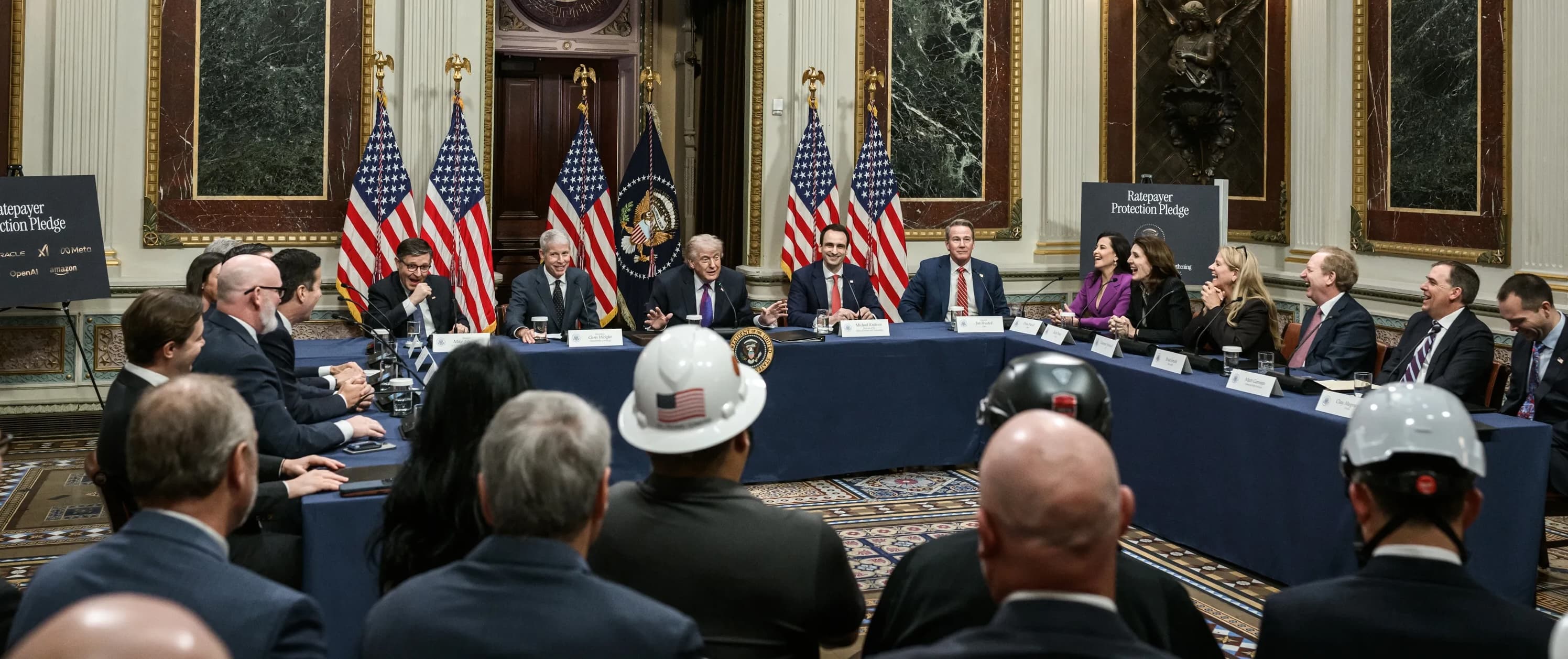
Tech companies make the government a promise: we will pay our own way. In March, Amazon, Google, Meta, Microsoft, OpenAI, Oracle, and xAI signed the Ratepayer Protection Pledge. They committed to building and paying for the new power and grid infrastructure their campuses require, rather than passing the cost on to households. In July, governors, utilities, and developers were brought in to make the same commitment. With the midterms approaching, an extra line on the electricity bill is bad politics.
But the bill is already arriving. The boom in energy infrastructure is showing up on household bills. Utilities order substations and transmission lines to serve gigawatts that still exist only on paper. Then the campus is delayed, or the project collapses altogether, while the equipment has already been purchased and installed. The one left paying is the one without a lobbyist: the residential ratepayer.
That is why, on June 18, FERC issued show-cause orders to six regional grid operators. At the center of the proceedings is one instrument: the Cost Recovery Agreement. If infrastructure is built for a data center that never comes online, residual customers should not be left holding the bill. If grid-upgrade costs hit electricity rates before the server racks light up, it should be equally clear who is responsible for paying. The deadline for the operators’ responses has been pushed to November. Texas’s ERCOT is not among the six: it falls under a different jurisdiction and is conducting its own audit of the queue.
TVA adopted its own rules for large-load connections earlier in the summer. In California, lawmakers struck a deal on August 29 covering data center energy and water use as well as protections for residential ratepayers: separate tariffs, disclosure requirements for electricity and water consumption, and a ban on shifting grid-upgrade costs onto residents. Google, Meta, Amazon, OpenAI, and Anthropic were all in the room. This is a deal about bills, not a statewide ban.
The formula is simple. Companies want guaranteed power as quickly as possible. The government decides who pays for the infrastructure, and what happens if a promised gigawatt remains nothing more than a line in the queue. The transformer is yours. So is the bill.
Local Veto
But even a fully paid-for transformer cannot be installed just anywhere. People are increasingly turning out to oppose data centers, filling township halls and county commission chambers. A Heatmap/Embold survey found that 75 percent of the public opposed having a data center near their homes; 61 percent were strongly opposed.
Their leverage is not FERC. It is zoning, permits, and public hearings. In late August, the Austin City Council voted to develop new land-use rules for large data centers and instructed officials to consider the strictest possible restrictions, including a potential ban on the largest facilities within city limits. Until then, data centers could still slide into legacy categories such as communications services, even though their energy footprint increasingly resembles that of heavy industry.
Pennsylvania took a similar path at the state level. AI data center projects were removed from the standard fast-track permitting process and made subject to new transparency requirements. State authorities also restricted the use of nondisclosure agreements that had kept residents from learning about the scale and energy demands of proposed projects until it was too late.
In New York, the conflict also reached the state level. On July 14, Governor Kathy Hochul signed Executive Order 62, imposing a one-year pause on discretionary environmental permits for new data centers of 50 megawatts or more while the state prepares a broader assessment of their cumulative environmental and energy impact.
On August 3, Texas halted Batch Zero of its interconnection process and ordered every large-load application to be reviewed: power requirements, water use, subsidies, and ownership. This is a directive, not a law. But the mechanism is the same. A project no longer secures land-use approval, permits, and a grid connection simply by promising massive investment.
There is no federal kill switch. Instead, there are dozens of points where a project can be slowed or stopped: zoning, permits, water, grid connections, and state regulations.
The question is no longer whether the United States needs more compute. Washington clearly thinks it does. The harder question is whether a local community still has the right to say no when the infrastructure behind that compute is increasingly treated as a matter of national competitiveness and security.
China: The State Asks No One
In the West, a data center must make its way through bruising public debate. China has already decided. From the top. The state determines where, when, and how much capacity will be built. The public does not object. Not openly, at least.
The 2026–2030 national five-year plan makes the priority clear: advance East Data, West Computing, build a layered computing infrastructure, and integrate it into a single national network.
This is not an industry shopping for its own sites. The central government designated eight national computing hubs and ten major clusters in advance, concentrates data centers there, and coordinates compute with electricity, networks, and data transmission. By March 2026, more than 80 percent of the intelligent computing capacity within the program was already concentrated in the eight national hub nodes. Official Chinese materials call centralized development one of the system’s defining features.
Beijing treats compute, electricity, and other resources as assets to be allocated nationally. The system is divided between east and west. Most AI companies and most of the demand are concentrated in the east. Five of the eight national hubs are in the west, where land and energy are easier to find. Workloads that are not latency-sensitive are pushed toward the regions where it is easier to pour concrete and generate power.
China did not abolish water consumption, noise, heat, land use, environmental damage, or competition for resources. It abolished the bottom-up political veto over a strategic decision.
Trump wants American leadership in AI. But the communities expected to host its infrastructure can still say no.