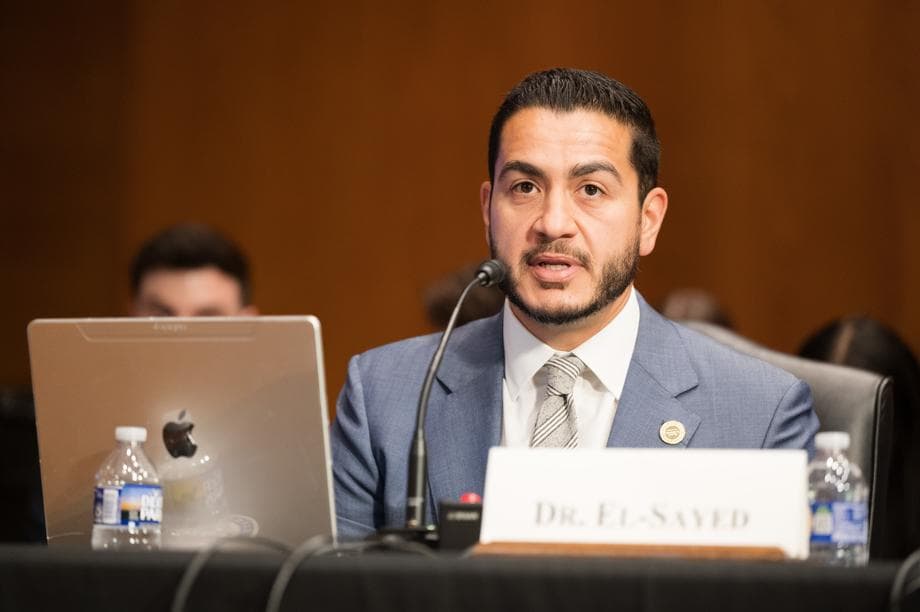
On the night of August 5, Steve Kornacki called Abdul El-Sayed’s victory in Michigan’s Democratic Senate primary live on NBC. At that moment, the Associated Press and most other outlets were still holding back.
A primary is not the general election. El-Sayed still faces a difficult race against Republican Mike Rogers. But the fact that he won inside his own party is already a strong signal, especially given who he is.
El-Sayed could become the first Muslim senator in U.S. history. He is running on positions that are unusually progressive for a swing state Donald Trump carried in 2024. More important is what his win reveals: how quickly what was recently considered the left flank of the Democratic Party is becoming a real contest for power.
And with that contest, the boundaries of what is politically possible in America are shifting, on Israel and the Middle East, on Ukraine, and on the regulation of artificial intelligence and Big Tech. One Senate candidate does not rewrite U.S. foreign policy. But his victory shows which ideas can now win a primary in a state that voted for Trump just two years ago.
Why El-Sayed Won
After the race was called, Abdul El-Sayed was suddenly everywhere on television. His primary victory was more than a personal success. It gave the Democratic left a chance to push the party toward harder positions on some of its most contentious domestic and foreign-policy issues.
He did not defeat a Republican. He defeated a fellow Democrat, Congresswoman Haley Stevens, who benefited from tens of millions of dollars in outside spending, much of it from groups linked to AIPAC. El-Sayed still prevailed.
He won despite Stevens’s enormous financial advantage. She entered the final stretch with much of the party establishment behind her and tens of millions in outside spending. El-Sayed ran as an outsider, against big money, against the party machine, and against the assumption that only a moderate could win in November.
His coalition looked different. El-Sayed performed especially well among younger and more liberal voters, as well as college-educated white voters. Arab-American voters were another important part of his coalition. Stevens was stronger among Black voters and in working-class areas. The primary revealed not just an ideological split, but two competing models of the Democratic coalition.
This is where El-Sayed’s economic populism paid off. Stevens sold electability: the argument that an experienced, more moderate candidate would be the safer choice against Rogers. El-Sayed made the opposite case. Democrats did not need the safest candidate, he argued, but one willing to openly confront the system: big donors, corporate interests and the structure of American healthcare. In the primary, that argument won out.
Who is he? The Michigan-born son of Egyptian immigrants. A Rhodes Scholar, a physician and a public-health specialist. He ran Detroit’s health department and later Wayne County’s. In 2018, he ran for governor and lost the Democratic primary to Gretchen Whitmer. His campaign has been funded mainly by individual donors, many of them doctors and members of the Arab-American community. His own campaign does not take corporate PAC money, though independent outside groups have also spent money on his behalf.
That is why many see his victory as close to an ideal scenario for Republicans. A nominee further to the left, a divided party and a bruising primary all make the November race against Mike Rogers more difficult for Democrats.
At the same time, it is also a signal to Trump. El-Sayed built his campaign around a simple formula: “Money out of politics, money in your pocket, and Medicare for All.” He has already said that if he reaches the Senate, one of the first things he wants to do is grill Health Secretary Robert F. Kennedy Jr.
Michigan is not a random battleground. It is a classic swing state with a powerful auto industry, a large Arab-American community and complicated electoral geography. Trump won it in 2024. For Republicans, holding or strengthening their position in Michigan is critical. For Democrats, it is one of the key states without which control of the Senate becomes extremely difficult.
Israel and a Deepening Democratic Divide
One of the sharpest divides exposed by El-Sayed’s victory is over the Middle East.
His position is uncompromising and clearly to the left of the Democratic mainstream. He does not merely criticize Benjamin Netanyahu’s policies. In an interview with CNN’s Kaitlan Collins, he said directly: “I don’t want to fund a foreign military that does genocide, apartheid, or has taken us to a war we don’t need to fight.”
On Morning Joe, he went further: “We’ve been talking about an illegal apartheid regime for a very, very long time, and that supersedes Netanyahu himself.”
American tax dollars, he says, should stay in Michigan. “I believe our responsibility though more than anything else is to use our tax money here in Michigan to provide healthcare in Michigan and schools in Michigan and roads in Michigan rather than to send it to a foreign government that might use it in the form of bombs and tanks to destroy infrastructure and schools and hospitals there.” He has repeatedly pointed out that some communities in his state have a median income of just $14,000.
This stance makes a deepening split inside the Democratic Party impossible to ignore. The progressive wing is moving more confidently toward forceful criticism of Israel. Moderate Democrats and much of the party establishment see that language as toxic and politically dangerous. That is why groups linked to AIPAC poured tens of millions of dollars into the campaign against El-Sayed, and still lost.
Even Senate Democratic leader Chuck Schumer initially backed Haley Stevens. After El-Sayed’s victory, he quickly shifted to calls for unity and attacked Mike Rogers as “a rubber stamp” for Trump. But the tension inside the party remains. Progressives see El-Sayed’s position as a matter of principle, while many moderates see a risk of losing Jewish voters and the political center.
Republicans take the opposite view. Mike Rogers is a staunch supporter of Israel and has made his pro-Israel position a central part of the campaign. After the attack on Temple Israel in West Bloomfield, Rogers issued a strong statement saying that antisemitism could not be allowed to take root and pledging to stand with Michigan’s Jewish community.
For Rogers and the Republican campaign, Israel is becoming one of the most obvious lines of attack. El-Sayed is already being portrayed as a candidate who hates Israel.
Michigan is divided too, and so is the reaction online. In Dearborn and within the Arab-American community, El-Sayed’s position draws strong support. On X after his victory, some users wrote that a candidate had finally emerged who was willing to call for an end to funding what they described as genocide, while others described his language as dehumanizing and antisemitic. Trump has already attacked El-Sayed directly, saying: “He doesn’t love Israel. He doesn’t love Jewish people. He hates them. He hates them with a passion…”
On one side, El-Sayed’s position strongly mobilizes Arab-American voters and younger progressives, especially in Dearborn and Detroit. That gives him a strong source of turnout.
On the other, it creates a real risk of losing some Jewish Democrats and moderate voters. After the primary, some Jewish Democrats in Michigan have already spoken publicly about the possibility of supporting Rogers. In a state where the Senate race is likely to be decided by a very narrow margin, that split could prove decisive.
Ukraine: No Radical Turn
On Ukraine, El-Sayed takes a different approach, one much closer to the Democratic mainstream.
As early as March 2022, already a prominent progressive voice after his 2018 gubernatorial run, he described the war as a confrontation between “democracy and autocracy, between self-government and fascism,” and called Putin an authoritarian dictator.
In an interview with the Detroit Free Press just before the primary, he put it even more clearly: “When it comes to Ukraine, I think we are involved in a righteous struggle to protect a sovereign nation from being invaded by their neighbor. That’s completely consistent with international law.”
He supports military aid to Kyiv. On Ukraine, he is not challenging the Democratic mainstream. He is part of it.
The picture on the Republican side is more complicated. Mike Rogers emphasizes “America First” in his remarks. He has repeatedly said that the United States should not write endless blank checks and criticized the previous administration for lacking a clear strategy. At the same time, in 2025 and 2026, after Trump’s return, Rogers publicly supported pressure on Moscow and argued that strength is the only language Putin understands.
For a long time, Trump’s own position on Ukraine was restrained, at times openly skeptical. But in July 2026, his position shifted noticeably. At the NATO summit in Ankara, he publicly praised Zelensky and promised Ukraine a license to produce Patriot systems: “We’re going to give a license to you to make Patriots. That’s pretty cool. This way, you can’t complain that we’re not giving ’em enough.”
Later in July, he partially walked it back. The technology, he said, was too sensitive: “it is a hard thing to give away that kind of technology” and “those people you give the technology, they could someday turn on you.” Putin, meanwhile, never received a new phone call after the summit in Turkey. No further contact followed.
This partial shift came against the backdrop of a serious drop in Trump’s approval ratings. According to the latest data from late July and early August, his approval stood in the 34–38% range, with net approval falling to around –20 or lower, among the weakest numbers of his second term.
We cannot prove a direct link between those ratings and Trump’s Ukraine maneuver. From the outside, though, it can look like an attempt both to adjust his foreign-policy course and to shore up his domestic standing.
In Michigan, El-Sayed’s position on Ukraine is calm, consistent and almost humanitarian in tone, sitting in striking contrast to his much harder line on the Middle East. For some voters who sympathize with Ukraine but are also tired of blank checks to foreign governments, he draws an easy-to-understand line: defending a sovereign country against direct aggression is one thing; territorial disputes and offensive military action are another.
AI: From Regulation to Public Control
In late June 2026, Abdul El-Sayed released a 22-point AI agenda called “AI Under Democracy.”
This was not another collection of general talking points. Under his plan, the largest AI companies would have to become public benefit corporations. A majority of board seats would be publicly appointed or democratically elected rather than controlled by shareholders. Google, Microsoft, Amazon and Meta would be required to divest their controlling stakes in frontier AI labs.
The plan also includes an “AI dividend” paid to the public, a tax on automation and strict rules for data centers: no electricity-rate hikes for local residents, job guarantees and environmental limits.
El-Sayed says AI and data centers now come up at almost every campaign stop. He positions himself as the only candidate in the Michigan race offering not just regulation, but public control.
This stance exposes another split inside the Democratic Party. Progressives including Bernie Sanders, Alexandria Ocasio-Cortez and Ed Markey are moving in the same direction: toward public ownership or stronger public control, pauses on data-center construction and taxes on computing power.
California Governor Gavin Newsom has taken a more pragmatic path. In 2025, he signed a landmark state law on frontier AI transparency and safety and has continued tightening rules at the state level while the federal government moves toward deregulation. Moderate Democrats in Congress remain torn between protecting workers and preserving America’s technological lead.
Republicans and Trump take the opposite position. Their logic is “Winning the AI Race”: minimal regulation, faster infrastructure development and competition with China. The central argument is that strict rules will slow American companies and hand an advantage to Beijing.
In Michigan, the issue is especially acute. The auto industry is already confronting automation. Factory Zero uses dozens of collaborative robots, while the plant has also seen substantial job cuts. Digital and AI skills are becoming increasingly important, while traditional manufacturing jobs remain under pressure.
That leaves El-Sayed in the classic trap of an industrial-state politician. On one side, he is expected to defend people who still make things with their hands. On the other, he risks looking like someone trying to slow technological progress at a moment when China has no intention of slowing down.
The choice is stark: protect the real economy and existing jobs now, or accelerate the technological race even if some people are left behind. El-Sayed is choosing the first.
Yet El-Sayed matters not because one senator could suddenly rewrite American foreign policy or the rules governing Big Tech. His victory shows something else: inside the Democratic Party, a political language is beginning to take shape that links healthcare, the cost of living, Israel, Ukraine, artificial intelligence and corporate power through a single question: where do American money and American power go, and who gets to decide?
That is why the Michigan primary reaches far beyond one state. If El-Sayed defeats Rogers in November, this logic will have a seat in the Senate.
If he loses, the argument will not disappear.